Saturday, August 1, 2015

Are Christians Under The Old Testament Law?

THE LAW
   There are four aspects of the Law that the Christian needs to understand in order to form a sound basis for understanding what the Law is and what its intent was as given by God.
  1. There are a total of 613 Laws
The first 10 that commonly are referred to as the Ten Commandments are not the Law. The Law is a singular word and it is used in Scripture to refer to this unit of 613.
  1. The Law was given by angels to Moses.
The angelic delivery was not revealed in the O.T. but was always in Jewish lore. It does appear in the N.T in three places.
Act 7:53  Who have received the law by the disposition of angels, and have not kept [it].
 Galatians 3:19 b [and it was] ordained by angels in the hand of a mediator.
 Hebrews 2:2  For if the word spoken by angels was stedfast, and every transgression and disobedience received a just recompense of reward;
  1. The Law had five purposes.
We will examine each in light of the Scripture that explains the purposes to us.  First we must fully understand that the Law was never a means of salvation. If that were true then salvation would be achieved by works and not by grace through faith. (Ephesians 2:8-9) Scripture is very clear on this point. Further if one in any dispensation could perform some human act to achieve salvation there would be no need for Christ to have come to earth and shed His blood. Now the content of faith changes from dispensation to dispensation or administration to administration. By content we mean that the level of revelation that God has made available to the particular dispensation. The individual’s faith can only be up to the level or content of what God has revealed within that dispensation. We believe in progressive revelation whereby God has chosen to reveal increasingly more about Himself as human history advances over time. The person who believes then is responsible to the “content” of faith that is available to him in each dispensation. We call them saints.
When an Old Testament Saint died, his body went into the ground and his soul went to Abraham’s Bosom because the sacrifices required by the Law were insufficient to get him into Heaven. They were sufficient to keep him out of Hell. Sin in every dispensation have to be removed by the blood of the Lord Jesus Christ. The Old Testament unsaved who died went to Hell. When Christ died he went to Hades (side 1), not Hell to free the captives. Today when a New Testament saint dies his body goes into the ground and his soul goes straight to Heaven. The unbelievers go straight to Hell. After the thousand-year reign of Christ on the earth (Millennium), the inhabitants of Hell, Tartarus, and the Abyss will be cast into the Lake of Fire. (The Greek word for the Lake of Fire is Gehenna, which means a burning garbage dump)
The Five Purposes are:
    1. To reveal the holiness of God and the standard of righteousness that God demanded.
    2. To Provide a conduct of life for the Old Testament Saint. The Law then was give to those who loved God and wanted to keep His commandments as much as humanly possible. Those who did not love God would have no desire to keep the law and fulfill its obligation. Eli’s sons are an example of this. The outward demonstration of a believer’s faith in the O.T. was to keep the Law.
Romans 3:20  Therefore by the deeds of the law there shall no flesh be justified in his sight: for by the law [is] the knowledge of sin.
Romans 3:28  Therefore we conclude that a man is justified by faith without the deeds of the law.
    1. To reveal sin. 
 Romans 3:19-20  Now we know that what things soever the law saith, it saith to them who are under the law: that every mouth may be stopped, and all the world may become guilty before God. Therefore by the deeds of the law there shall no flesh be justified in his sight: for by the law [is] the knowledge of sin. Moreover the law entered, that the offence might abound. But where sin abounded, grace did much more abound:
 Romans 7:7  What shall we say then? [Is] the law sin? God forbid. Nay, I had not known sin, but by the law: for I had not known lust, except the law had said, Thou shalt not covet.
    1. To make one sin more. The sin nature uses the Law as a basis of operation. So as the Law becomes known humans have a tendency to want to challenge the Law by increased sin. One statement that helps to clarify this is when one it told to follow the Law that person will say, “Oh yeah? Well make me!’ Therefore the level of sin grows and becomes more evident.
Romans 4:15  Because the law worketh wrath: for where no law is, [there is] no transgression.
Romans 7:8  But sin, taking occasion by the commandment, wrought in me all manner of concupiscence. For without the law sin [was] dead.
Romans 7:9-13  For I was alive without the law once: but when the commandment came, sin revived, and I died. And the commandment, which [was ordained] to life, I found [to be] unto death. For sin, taking occasion by the commandment, deceived me, and by it slew [me].Wherefore the law [is] holy, and the commandment holy, and just, and good. Was then that which is good made death unto me? God forbid. But sin, that it might appear sin, working death in me by that which is good; that sin by the commandment might become exceeding sinful.
 I Corinthians 15:56  The sting of death [is] sin; and the strength of sin [is] the law.
    1. To lead us to faith. It did this as our tutor or teacher as the Apostle Paul tells us in Galatians 3:24.
Galatians 3:24  Wherefore the law was our schoolmaster [to bring us] unto Christ, that we might be justified by faith.

4.THE LAW HAS COME TO AN END
We must realize that the Mosaic Law has come to an end. It is no longer operative and it has fulfilled its purpose. Some believe that there are three sections of the Law; the ceremonial, the moral and the civil; and the moral is continued in the New Testament. The moral aspects of God’s desire for us have been restated in the N.T. It is not a rehashing of the Law nor has the Law passed through to the N.T. We must realize that the Law expired and is no longer operative at all. As mentioned earlier the Law had 613 individual components but they were regarded as one unit. Therefore if one of the 613 was broken then the entire Law was violated. Because the blood of Christ fulfilled all the requirements of the Law it provides the believer all that is necessary for righteous behavior and salvation as well.
Romans 10:4  For Christ [is] the end of the law for righteousness to every one that believeth.
So Christ give us His righteousness at the moment of salvation.
Of the various components of salvation there are two that need to be noted.
Justification and Sanctification
The Law justifies no one.
Romans 3:20  Therefore by the deeds of the law there shall no flesh be justified in his sight: for by the law [is] the knowledge of sin.
The Law also sanctified no one. It made nothing perfect.
Hebrews 7:19  For the law made nothing perfect, but the bringing in of a better hope [did]; by the which we draw nigh unto God.
The Law was temporary until the Seed would come. (the seed of the woman is Christ)
Galatians 3:19a Wherefore then [serveth] the law? It was added because of transgressions, till the seed should come to whom the promise was made;
 With the change from the Law of Moses to the Law of Christ came a change in the priesthood.
Hebrews 7:11-14  If therefore perfection were by the Levitical priesthood, (for under it the people received the law,) what further need [was there] that another priest should rise after the order of Melchisedec, and not be called after the order of Aaron? For the priesthood being changed, there is made of necessity a change also of the law. For he of whom these things are spoken pertaineth to another tribe, of which no man gave attendance at the altar. For [it is] evident that our Lord sprang out of Juda; of which tribe Moses spake nothing concerning priesthood.
 The O.T priest had to be of the tribe of Levi and the Kings all had to be of the tribe of Judah. Since Christ is of the tribe of Judah the New Covenant accommodates this by annulling the Law. Christ is a King and a Priest after the order of Melchisedec.
 Hebrews 7:18-19  For there is verily an (annulling) of the commandment going before for the weakness and unprofitableness thereof. For the law made nothing perfect, but the bringing in of a better hope [did]; by the which we draw nigh unto God.
 The Law was a wall of separation between the Jews and the Gentiles.
Ephesians 2:11-15  Wherefore remember, that ye [being] in time past Gentiles in the flesh, who are called Uncircumcision by that which is called the Circumcision in the flesh made by hands; That at that time ye were without Christ, being aliens from the commonwealth of Israel, and strangers from the covenants of promise, having no hope, and without God in the world: But now in Christ Jesus ye who sometimes were far off are made nigh by the blood of Christ. For he is our peace, who hath made both one, and hath broken down the middle wall of partition [between us]; Having abolished in his flesh the enmity, [even] the law of commandments [contained] in ordinances; for to make in himself of twain one new man, [so] making peace;
 Ephesians 3:5-6  Which in other ages was not made known unto the sons of men, as it is now revealed unto his holy apostles and prophets by the Spirit; That the Gentiles should be fellowheirs, and of the same body, and partakers of his promise in Christ by the gospel:
There are four unconditional covenants that God made with the Jews.
  1. The Abrahamic
  2. The Land (Palestine)
  3. Davidic
  4. New Covenant
Each had spiritual and material blessings. As long as the Mosaic Covenant was in effect there was no way for Gentiles to enjoy the blessings of the Covenants. The only way for them to join in these blessings was to become proselytes. This was the legal separation between the two groups.
Daniel E. Woodhead


.

Wednesday, July 15, 2015

NEW COMMENTARY BY DR. WOODHEAD

THE BOOK OF ZECHARIAH - GOD REMEMBERS THE FUTURE OF ISRAEL

The name Zechariah comes from the Hebrew verb zakar that means “remember”. The last half of his name is a reference to the Lord as Yah.Therefore the meaning of the name of Zechariah is that of the “Lord remembering” and is a fitting one because the entire prophecy is one in which the Lord remembers Israel.

Zechariah is quite a common name in the Old Testament where it is found forty three times and references at least twenty different individuals. The prophecies in this book are covering the time from about 520 B.C. through to the time of the second coming of the Messiah.
This book may be viewed as the Old Testament apocalypse, or the continuation of prophecies of
the prophet Daniel. This book has great importance today because it give insight into God’s mind and His plans for Israel which are still future to us today.

Zechariah was born in Babylon and was both a prophet and a priest.
He was a contemporary of Ezekiel, Daniel, and Haggai. Haggai and Daniel
were much older than Zechariah and had seen the Temple in Jerusalem before
its final destruction in 586 B.C. by the Babylonians (Haggai 2:3). In 539 B.C.
the Persian emperor Cyrus conquered Babylon and ruled with a completely
different attitude towards the Jews and Jerusalem. Cyrus granted the Jews
permission to return to rebuild Jerusalem and their Temple in 536-35 B.C.
In 530 B.C. the son of Cyrus, Cambyses II, succeeded him. Darius I succeeded
Cambyses II in 522 B.C. It was during Darius I’s reign that the Lord gave
Zechariah his prophecies. Click on this link to order it now.

http://doctorwoodhead.com/commentary-on-zechariah/


Monday, June 15, 2015

Jesus Did Claim to be The Messiah of Israel?

Jesus Reveals His True Nature and Mission to an Inferior Samaritan Woman

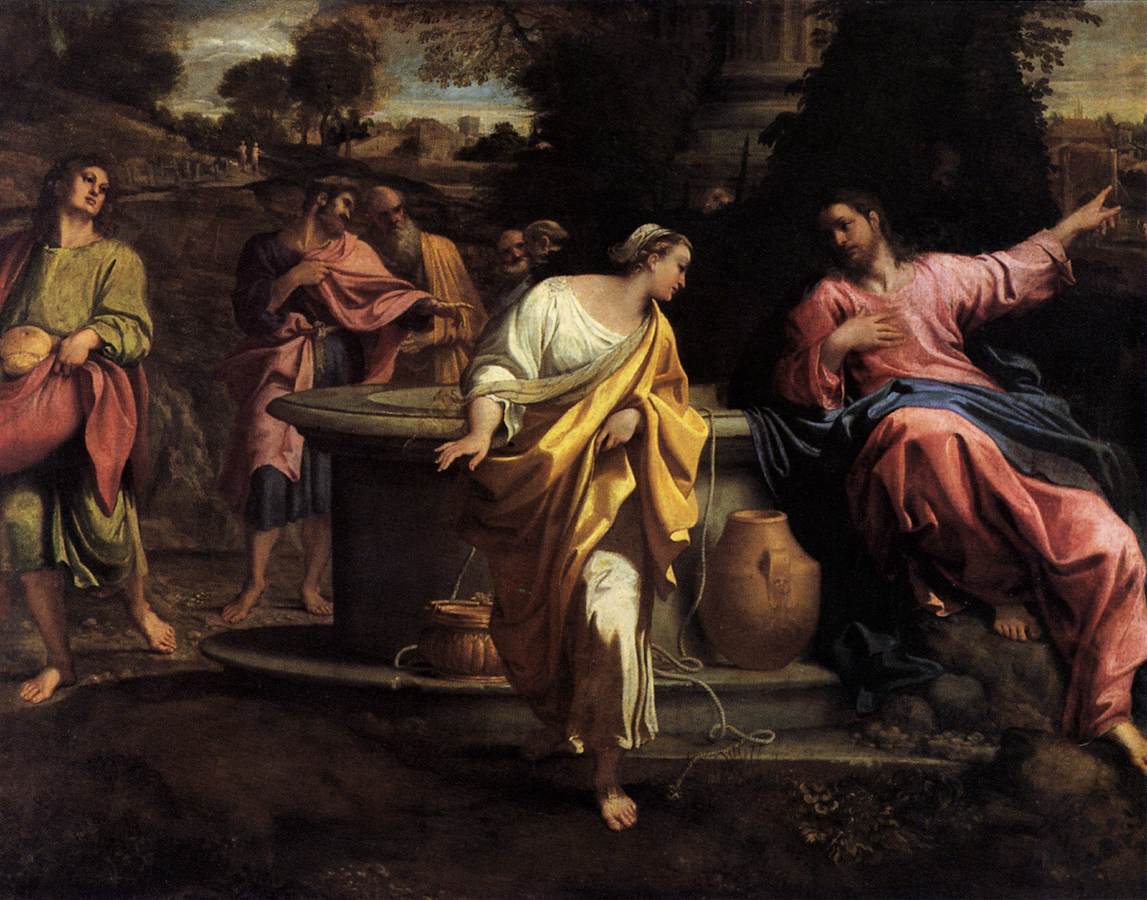
The Samaritan Woman at the Well by Annibale Carracci Cir 1560-1609
Some of the Bible’s and the Lord Jesus’ detractors say that He never claimed to be the Christ. Well He did and revealed himself to a lowly Samaritan woman not to the arrogant religious authorities of His day.
John 4:1-4
1 When therefore the Lord knew how the Pharisees had heard that Jesus made and baptized more disciples than John, 2 (though Jesus himself baptized not, but his disciples,) 3 he left Judea, and departed again into Galilee. 4 And he must needs go through Samaria (KJV).
The Lord Jesus needed to go through Samaria on His way back to Galilee. He had previously told His disciples not to go the way of the Gentiles or to enter into any city of the Samaritans. (Matthew 10:5) His first mission on earth was to present Himself to National Israel. (Matthew 10:6; 15:24) He wanted Israel to have the first chance at the gospel and He did not want the disciples time diluted with trying to reach the Gentiles along with the Jews. Even now the gospel is to go to the Jews first then the Gentiles. (Romans 1:16; 2:10) The Lord did not create foreign missions and domestic missions. He simply said “go to the Jew first and then the Gentiles.”
When the Israelites divided into two kingdoms, because of the civil war after the death of King Solomon, the Kingdom of Israel was established in the northern section of the Promised Land, in accordance with the lands allotted to the ten tribes in that area.
Shechem was the original capital, until Jeroboam moved it to Tirzah. Later, in approximately 880 B.C., Omri, the sixth king of Israel, established the capital at Samaria, a new town built on a hilltop about 7 miles (11 kilometers) northwest of Shechem.
“Samaria” came to be used interchangeably for both the city, and the region. After the Assyrians conquered the northern kingdom in 722 B.C., the region then known as Samaria was reduced in size. The Assyrians in their conquest raped women and repopulated the area with other people groups causing the next generation to become half-breeds. This group of Samaritans worshipped Jehovah the same as the Jews and followed the Torah. Because of their arrogance the Jews would not talk or deal with the Samaritans in any way except to sell to them.
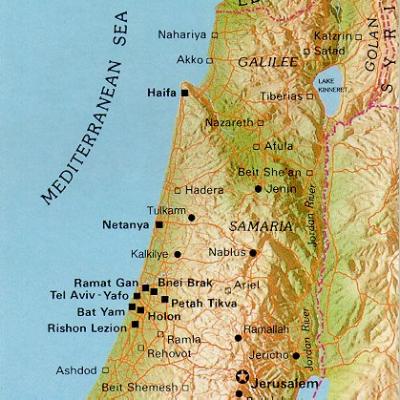
By the time of Jesus Christ, Samaria was bounded by Galilee to the north, The Mediterranean Sea to the west, Judea to the south (in which Jerusalem was located), and the Jordan River to the east. Today, it is in the so-called “West Bank” area.
Map of Samaria from Daily Bible study. http://www.keyway.ca/htm2002/samaria.htm
John 4:5-6
5 Then cometh he to a city of Samaria, which is called Sychar, near to the parcel of ground that Jacob gave to his son Joseph. 6 Now Jacob’s well was there. Jesus therefore, being wearied with his journey, sat thus on the well: and it was about the sixth hour (KJV).
Picture the Lord in His humanity resting by this special and providential well. He makes an opportunity to begin to reach the Samaritans with His message about who He actually is. He waited for a fallen poor woman whose story He knew well. This is one example of His divine grace reaching out to sinners with compassion. The greater the sin in our lives the greater then is the value of the forgiveness, which He offers. Only God can truly forgive sins. (Luke 5:21) For it is to Him that all sin is directed, whether we realize it or not. (II Samuel 2:13)
Christ and the Samaritan Woman at the Well by Jacob van Oost cir 1668
Samaritan woman
John 4:7-9
7 There cometh a woman of Samaria to draw water: Jesus saith unto her, Give me to drink. 8 (For his disciples were gone away unto the city to buy meat.) 9 Then saith the woman of Samaria unto him, How is it that thou, being a Jew, askest drink of me, which am a woman of Samaria? For the Jews have no dealings with the Samaritans (KJV).
She realized that He was Jewish and astonished at the same time that He would have anything to do with her. He simply asks her for some water. It was just she and He alone. He realizes that she is ignorant and exhibits much patience with her in His desire to reach her with the truth of who He is. This is a much different way He treats her than He does with the Jewish religious rulers. For them, he had little patience and heaped upon them much condemnation. (Matthew 23) They should have known better. She was an innocent bystander so to speak on religious matters.
John 4:10-13
10 Jesus answered and said unto her, If thou knewest the gift of God, and who it is that saith to thee, Give me to drink; thou wouldest have asked of him, and he would have given thee living water. 11 The woman saith unto him, Sir, thou hast nothing to draw with, and the well is deep: from whence then hast thou that living water? 12 Art thou greater than our father Jacob, which gave us the well, and drank thereof himself, and his children, and his cattle? 13 Jesus answered and said unto her, Whosoever drinketh of this water shall thirst again (KJV).
Now she is perplexed. Jesus begins to bring up water that she is not aware of, for she is thinking of actual water. But Jesus is speaking of a much greater water that that. He is speaking of the Holy Spirit, which is known as the water. (John 7:37-38) Jesus is always answering a different question than what was asked. In this instance Jesus is telling the woman that the water He brings will not quench thirst but would provide eternal satisfaction.
John 4:14-15
14 but whosoever drinketh of the water that I shall give him shall never thirst; but the water that I shall give him shall be in him a well of water springing up into everlasting life. 15 The woman saith unto him, Sir, give me this water, that I thirst not, neither come hither to draw (KJV). 
She was probably still thinking of actual water and not realizing the spiritual lesson He is teaching her. Never thirsting is a description of the fulfillment that saving grace knowledge of Christ brings to a human being. It provides purpose to our lives and gives us certainty of life eternal and allows us to endure the hopelessness that many on this earth are saddled with. This Christ satisfies the inner longing that each person on this earth has for significance and inner peace. Many try to find it through money, sex, intoxicants, work etc. But until we accept Christ and are filled with His Spirit we are continually longing for something that we can’t quite define.
John 4:16-19
16 Jesus saith unto her, Go, call thy husband, and come hither. 17 The woman answered and said, I have no husband. Jesus said unto her, Thou hast well said, I have no husband: 18 for thou hast had five husbands; and he whom thou now hast is not thy husband: in that saidst thou truly. 19 The woman saith unto him, Sir, I perceive that thou art a prophet (KJV).
 Jesus now enters a phase of the conversation where He is going to uncover her sin. This is a self-realization that one must make. We are sinners by our very nature. When the Jews came to the Tabernacle and the Temple the very first step in that ancient worship process was the brazen altar. This was where the sacrifice took place. They were required to offer sacrifice to God so as to admit their sin and receive the temporary atonement. The same is true today. We must admit our sins in front of God to Him alone so we can draw close to Him.
John 4:20
20 Our fathers worshipped in this mountain; and ye say, that in Jerusalem is the place where men ought to worship (KJV).
The new worship is going to be introduced in the next verse. She was thinking He was going to tell her that the Temple in Jerusalem was where she should worship. The Samaritans worshipped on Mt Gerizim. She was pointing to that mountain as the place where their fathers had worshipped. This was the mountain where Sanballat had built a temple that was eventually destroyed by John Hyrcanus in 129 B.C. Sanballat was one of the chief opponents of Nehemiah when he was building the walls of Jerusalem and carrying out his reforms among the Jews. “Sanballat,” is connected with the Assyrian “Sinballidh,” and means, “Sin has vivified.” He was called also “the Horonite,” and was associated with Tobiah the Ammonite and Geshem the Arabian (Nehemiah 2:19, 4: 7). But his home was at Samaria. When the Jews threw off the yoke of the Greeks under John Hyrcanus that temple was destroyed.
John 4:21-24
21 Jesus saith unto her, Woman, believe me, the hour cometh, when ye shall neither in this mountain, nor yet at Jerusalem, worship the Father. 22 Ye worship ye know not what: we know what we worship: for salvation is of the Jews. 23 But the hour cometh, and now is, when the true worshippers shall worship the Father in spirit and in truth: for the Father seeketh such to worship him. 24 God is a Spirit: and they that worship him must worship him in spirit and in truth (KJV).
Jesus now begins to tell her of the dawning of the Christian era. Now we have no need for a Temple. Our bodies are now the holy Temple. This is where the Spirit takes up residence after a person accepts Christ and becomes “saved.” He is telling her that she will not have to worship the Father on any mountain or in Jerusalem. This only pertains to “true” worshippers. That is, those that love God and have accepted His salvation that He offers through Christ alone (John 14:6) Since God is spirit we worship Him in spirit too. We don’t have to go to some particular location to worship God. Anywhere will do so to speak.
Salvation comes through the Jews. It was given at the time of the Abrahamic Covenant. This is one of the unconditional covenants that God made with Israel. The Abrahamic Covenant promised a seed, land, and blessings. The three major promises of this covenant were personal promises to Abraham, national promises to Israel and universal promises to all the people of the earth. God promised that He would bless him and make him a blessing to others, to make his name great, to give him many descendants, to make him the father of a multitude of nations, to give him the land of Canaan for always and to bless them that blessed Abraham and to curse them that cursed him. (Genesis 12; 13; 15 & 17) God also made national promises concerning Israel. They are: to make a great nation of his descendants; to give land from the river of Egypt to the Euphrates to his descendants forever; and to give the Abrahamic covenant to his descendants for ever. Finally, God made universal covenants to Abraham that would affect everybody on the earth; it would affect all families of the earth who would be blessed. This promise is intended to be applicable to Israel regarding the blessing and cursing effects. Parts of the covenant have already been fulfilled. For example God did bless him with wealth. His name is great and Israel is a great nation. The blessings to all have been given to all through the oracles of God they received and they brought forth the Messiah. The promise of the land has not been completely fulfilled yet. His descendants are in the land but, in unbelief and do not have the boundaries set forth in Scripture as of yet.
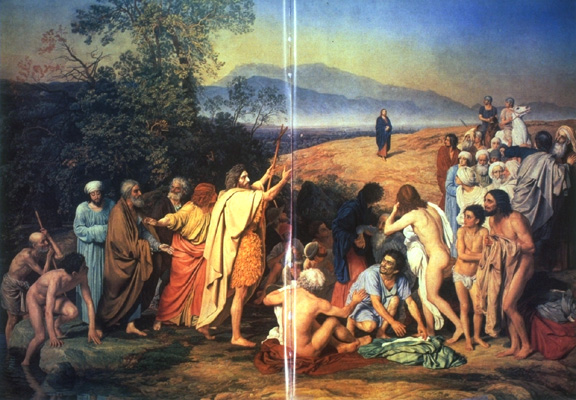
Appearance of the Messiah by Alexandr Ivanov Cir.1806-1858
John 4:25-26
25 The woman saith unto him, I know that Messias cometh, which is called Christ: when he is come, he will tell us all things. 26 Jesus saith unto her, I that speak unto thee am he (KJV).
Jesus answers her about this Messiah that she knew was coming. The Jewish writings were rife with a God-Man that would appear on the planet some day and remove all of Israel’s problems. In Hebrew the word for this God-man is Mashiach which Anglicized is Messiah. It is the same as the Greek Christos or Christ.  Jesus tells her that He is the long awaited Jewish Messiah.
Some of the prophetic writings about Him are in the Old Testament, which is the Jewish Bible at the time of Christ. They have been fulfilled in Jesus just as He told this Samaritan woman.
Some OT Messianic Prophecies and their New Testament fulfillment:
  1. Born in Bethlehem:                 Micah 5:2 Fulfilled in Matthew 2:1
  2. The Son of God:                     Psalm 2:7 Fulfilled in John 3:16-17
  3. Of the tribe of Judah:              Genesis 49:10 Fulfilled in Hebrews 7:14
  4. Of a virgin:                              Isaiah 7:14 Fulfilled in Matthew 1:18-22
  5. A prophet like Moses:           Deuteronomy 18:15 Fulfilled in John 7:15-17
  6. The King of Israel:                  Zechariah 9:9 Fulfilled in John 12:12-15
  7. Rejected:                                 Isaiah 53:3 Fulfilled in John 1:11
  8. Beaten:                                    Micah 5:1 Fulfilled in Mark 15:19
  9. Silent:                                      Isaiah 53:7 Fulfilled in Matt 27:12-14
  10. Betrayed:                                Psalm 41:9 Fulfilled in Mark 14:17-20’
  11. Tried and condemned:             Isa 53:8 Fulfilled in Matthew 27:1-2
  12. Crucified:                                Psalm 22:16 Fulfilled in John 19:17-18
  13. His garments divided:             Psalm 22:18 Fulfilled in John 19:23-24
  14. Given vinegar and gall:            Psalm 69:21 Fulfilled in John 19:31-36
  15. His bones not broken:             Exodus 12:46 Fulfilled John 19:31-36
  16. He is our sacrifice:                  Isaiah 53:5-6 Fulfilled in 1 Peter 2:24-25
  17. And raised from death:           Psalm 16:10 Fulfilled in Luke 24:1-7, 47

Daniel E. Woodhead 

Friday, May 22, 2015

Nothing Has or Ever Will Stop God's Plans

Judah's Sons,Tamar, and The Messianic Line


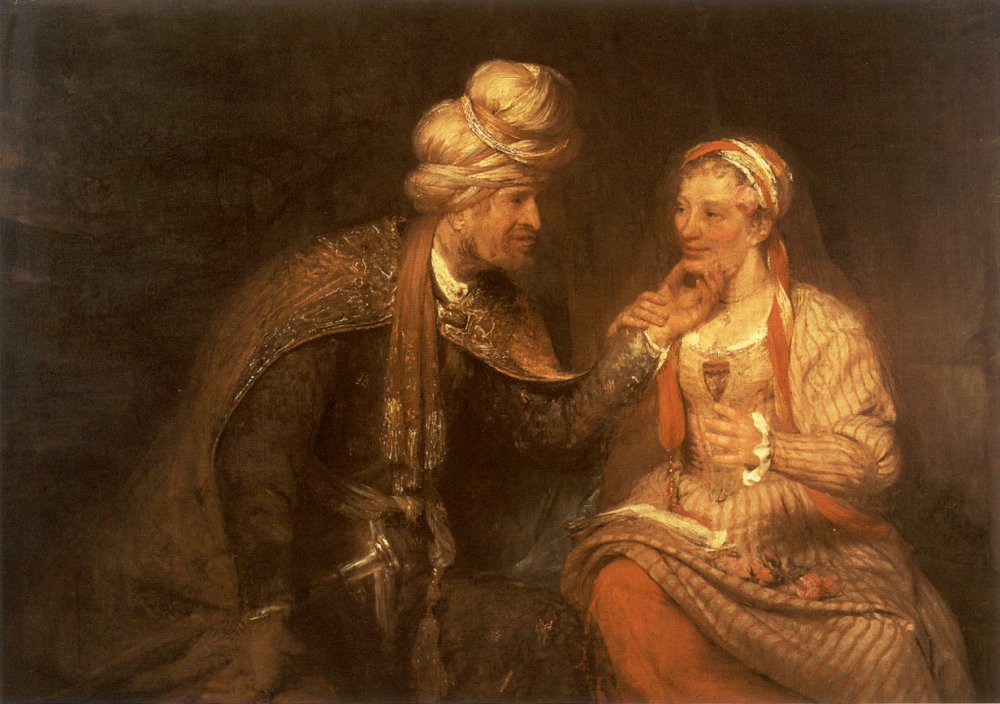
Judah and Tamar by Arent de Gelder cir. 1681
Genesis 38: 1-11
1And it came to pass at that time, that Judah went down from his brethren, and turned in to a certain Adullamite, whose name was Hirah. 2And Judah saw there a daughter of a certain Canaanite whose name was Shua. And he took her, and went in unto her. 3And she conceived, and bare a son; and he called his name Er. 4And she conceived again, and bare a son; and she called his name Onan. 5And she yet again bare a son, and called his name Shelah: and he was at Chezib, when she bare him. 6And Judah took a wife for Er his first-born, and her name was Tamar. 7And Er, Judah’s first-born, was wicked in the sight of Jehovah. And Jehovah slew him. 8And Judah said unto Onan, Go in unto thy brother’s wife, and perform the duty of a husband’s brother unto her, and raise up seed to thy brother. 9And Onan knew that the seed would not be his; and it came to pass, when he went in unto his brother’s wife, that he spilled it on the ground, lest he should give seed to his brother. 10And the thing which he did was evil in the sight of Jehovah: and he slew him also. 11Then said Judah to Tamar his daughter-in-law, Remain a widow in thy father’s house, till Shelah my son be grown up; for he said, Lest he also die, like his brethren. And Tamar went and dwelt in her father’s house (ASV 1901).
Judah, who was aligned with Reuben in steering the other sons of Jacob away from killing Joseph left them and travelled to Adullam. This was a town in the Judean lowlands southwest of Bethlehem. It later in the invasion under general Joshua was made a part of the tribal inheritance of Judah and it was also associated with the life of David (I Samuel 22: 1-2 etc.). Judah must have had a disagreement with his siblings regarding the disposition of Joseph because he chose not to stay with them. This account will span a time frame of approximately twenty-three years.
In Adullam Judah meets and befriends a man named Hirah. Through Hirah he is introduced to Shua who has a marriageable daughter. So he marries this unnamed Canaanite woman and ends up having three children with her. Interestingly, both Abraham and Isaac went to great lengths to prevent their children from marrying Canaanite women. Esau of course violated that and intermarried with the Canaanites and the Ishmaelites. Judah who was of the chosen family line began the intermarriages into the Canaanites. The text simply says that he took her, and went in unto her. He then had three sons by her: Er (×¢ֵר), Onan, and Shelah. Judah named Er and his wife named Onan and Shelah since he was away in the nearby town of Chezib. Hebrew naming shows the parents wish to commemorate some meaningful event through the child’s name. Er means forsaken or lonely. Onan means sorrow and Shelah means deception. This seems to indicate that Judah was quite remorseful over the events that brought Joseph into slavery into Egypt.
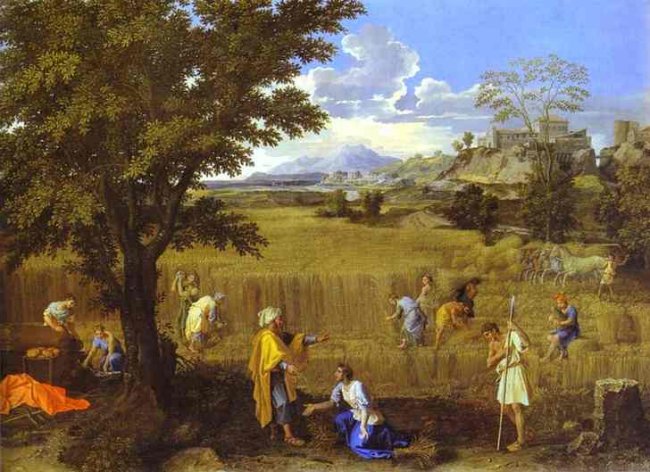
When Er was grown he was married to a woman named Tamar. The text further tells us that he was wicked in the sight of Jehovah. The Hebrew word for wicked is ra ×¨ַ×¢. It is a designation of a degree of wickedness that merits divine retribution. And in this case his death was the result of Jehovah God taking his life in some undisclosed manner. Jehovah who knows all things was keeping Tamar from this evil man. As a result of his death Judah instructs the second born son Onan to do his duty and “Go in unto thy brother’s wife, and perform the duty of a husband’s brother unto her, and raise up seed to thy brother.” This concept is called the law of levirate marriage. It was codified into the Mosaic Law and became a standard practice (Deuteronomy 25: 5-6, Ruth 4: 5-6; Matthew 22: 24). The idea was to keep the name of the individual who died through his son. This would also preserve an in family transfer of land and material wealth. The first-born son would be the heir and would also have an obligation along with the new husband to care for the widow. Widows in ancient Israel would be forced to beg without this law. So in this way the widow was protected from becoming destitute. Finally, the son would keep the family name alive even though the father was not alive to propagate. One clear example of this is the marriage of Ruth to Boaz
Summer (Boaz and Ruth) by Nicholas Poussin cir. 1660-64

 Levirate Marriage

Deuteronomy 25: 5-6
5If brethren dwell together, and one of them die, and have no son, the wife of the dead shall not be married without unto a stranger: her husband’s brother shall go in unto her, and take her to him to wife, and perform the duty of a husband’s brother unto her. 6And it shall be, that the first-born that she beareth shall succeed in the name of his brother that is dead, that his name be not blotted out of Israel (ASV 1901).
Onan seemed to have no qualms against marrying Tamar Er’s widow. He seemed to accept the easy part of having sexual intercourse with her and accepting his inheritance. Er was first born so he would have gotten Judah’s estate when he passed. Er realized this and complied with Judah’s instructions. However, Onan realized that the children would not be his per se but that of Er’s so during intercourse with Tamar he continually withdrew from her before he deposited his semen into her. Thus, she was not allowed to become pregnant. Some mistakenly teach through this example here that God prohibits contraception. The sin here was, Onan did not want to obey his father and honor his brother by taking up the responsibility that was given to him. Because his sin was in the same category of wickedness of his brother Er the Lord executed His divine will and caused him to die too. Tamar was now a widow again and Judah instructed her to “Remain a widow in thy father’s house, till Shelah my son be grown up; for he said, Lest he also die, like his brethren.” Judah was certainly considering Tamar to have some major issue that both her husbands received divine executions. So he told her that when his third son Shelah was of age she could have him in levirate because he feared that Jehovah would take him too. Judah had no intention of letting Tamar marry Shelah because of the curse he thought she had. She trusted Judah and went to her father’s home to live and wait for Shelah to come of age and marry her.

The Strange Case of Tamar and Judah

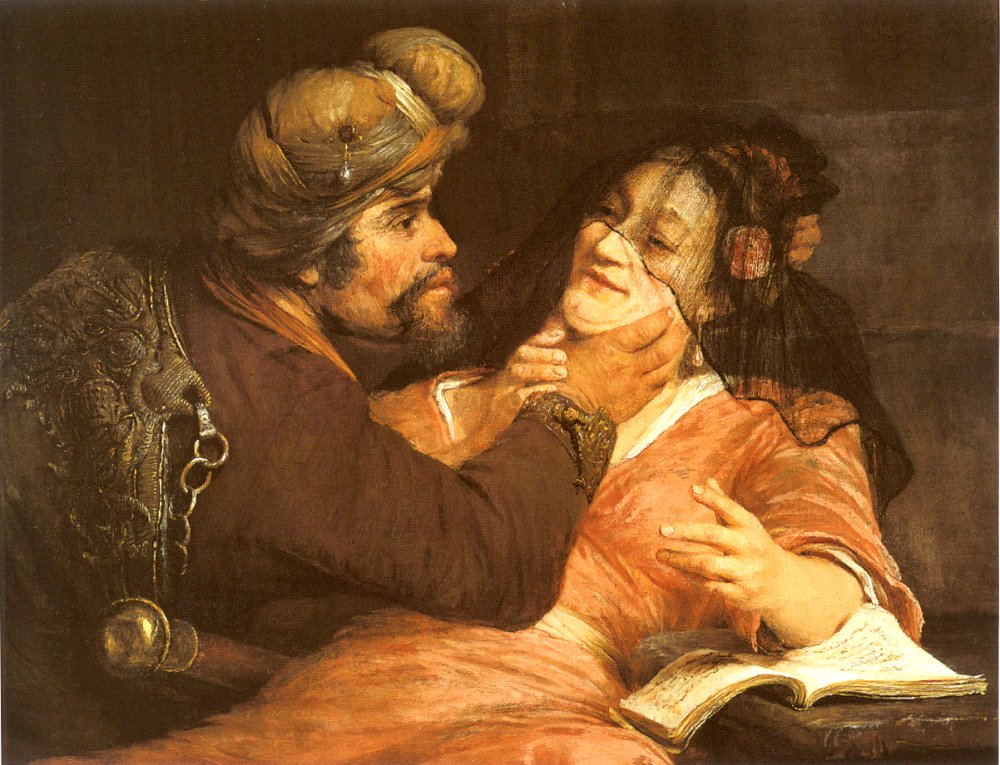
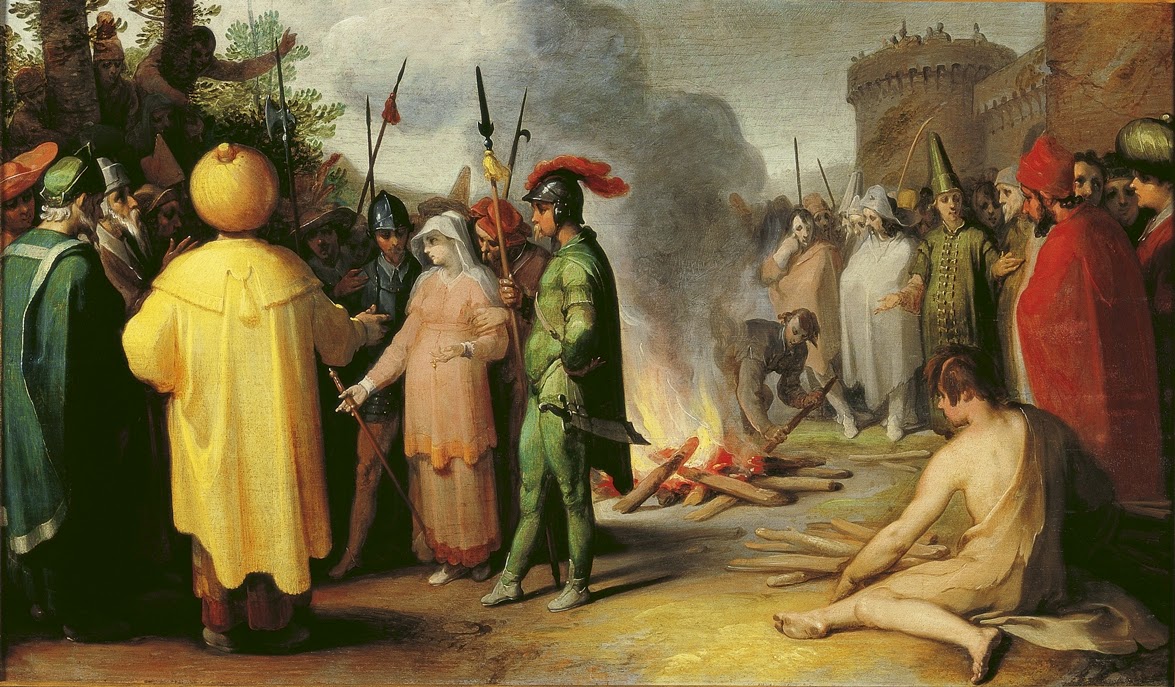
Judah and Tamar by Arent de Gelder Cir 1667
Genesis 38: 12-26
12And in process of time Shua’s daughter, the wife of Judah, died; and Judah was comforted, and went up unto his sheep-shearers to Timnah, he and his friend Hirah the Adullamite. 13And it was told Tamar, saying, Behold, thy father-in-law goeth up to Timnah to shear his sheep. 14And she put off from her the garments of her widowhood, and covered herself with her veil, and wrapped herself, and sat in the gate of Enaim, which is by the way to Timnah; for she saw that Shelah was grown up, and she was not given unto him to wife. 15When Judah saw her, he thought her to be a harlot; for she had covered her face. 16And he turned unto her by the way, and said, Come, I pray thee, let me come in unto thee: for he knew not that she was his daughter-in-law. And she said, What wilt thou give me, that thou mayest come in unto me? 17And he said, I will send thee a kid of the goats from the flock. And she said, Wilt thou give me a pledge, till thou send it? 18And he said, What pledge shall I give thee? And she said, Thy signet and thy cord, and thy staff that is in thy hand. And he gave them to her, and came in unto her, and she conceived by him. 19And she arose, and went away, and put off her veil from her, and put on the garments of her widowhood. 20And Judah sent the kid of the goats by the hand of his friend the Adullamite, to receive the pledge from the woman’s hand: but he found her not. 21Then he asked the men of her place, saying, Where is the prostitute, that was at Enaim by the wayside? And they said, There hath been no prostitute here. 22And he returned to Judah, and said, I have not found her; and also the men of the place said, There hath been no prostitute here. 23And Judah said, Let her take it to her, lest we be put to shame: behold, I sent this kid, and thou hast not found her. 24And it came to pass about three months after, that it was told Judah, saying, Tamar thy daughter-in-law hath played the harlot; and moreover, behold, she is with child by whoredom. And Judah said, Bring her forth, and let her be burnt. 25When she was brought forth, she sent to her father-in-law, saying, By the man, whose these are, am I with child: and she said, Discern, I pray thee, whose are these, the signet, and the cords, and the staff. 26And Judah acknowledged them, and said, She is more righteous than I; forasmuch as I gave her not to Shelah my son. And he knew her again no more. (ASV 1901)
So time passed and Judah was making no effort to arrange another levirate marriage between Shelah and Tamar who desired children and not wanting to make a career of widowhood. She was still a young woman. Judah’s wife died and he went through a period of ritual mourning as the text says that and Judah was comforted. Later he and his friend Hirah went up to the sheep-shearers. This was a festive time for them and Judah now done with mourning was going to join in the party atmosphere.
Tamar became aware of Judah’s travel to the party with the sheep shearers with Hirah and she devised a plan to force him into a role of a levir for her. In her contrivance she planned to entrap him. She changed out of her widow’s clothes and made herself appear as an adherent of Astarte, which was a sacred prostitute. She then put on a veil, which had several connotations of that day. Brides principally wore them on their wedding night and so did prostitutes wanting to appear as a wholesome bride. So a veiled woman in public gave off the message that she was a prostitute available for sexual intercourse. She had essentially dressed herself as a cult prostitute and waited for Judah to appear at the city gate of Enaim. Her actions while retaliatory for not getting Shelah put her into a doubly sinful situation. She was legally betrothed to Shelah regardless of what Judah was preventing and she was planning on an incestuous relationship with Judah.
When Judah saw her he was enticed by her. She played the role of seductress and lured him into a sexual union. It was Judah who suggested the sex when he said to her, ”Come, I pray thee, let me come in unto thee: for he knew not that she was his daughter-in-law.” He was coming off a period of mourning and was exceptionally vulnerable to temptation of this sort and didn’t realize that this was his daughter-in-law in disguise. Tamar who played the role of a prostitute asked for payment for gratifying his sexual desires. This was a normal request from a prostitute. She says, “What wilt thou give me, that thou mayest come in unto me?” He promised her a kid of the goats of the flock at a later time for sexual favors now, but she did not trust him and wanted something of more significance as a promissory to pay. She was actually looking for something to provide as evidence proving him to be the father of the child who would come from the union. So Judah asks, “What pledge shall I give thee? She being very savvy says to him in response, “Thy signet and thy cord, and thy staff that is in thy hand.” These three items had identifying significance for her to later prove who the father’s child was. The signet was used to seal documents, the cord was a necklace that the ring was kept on, and the staff in his hand established his profession. So she received them and she had sex with him, after which she became pregnant. She then left, removed the veil and put back on the widow’s clothes.
Judah then tried to make good on the promise to give her a goat kid. He sent Hirah to her with the payment. He of course wanted his personal items back, which she was holding as a deposit. When Hirah was unable to find her he begins asking the men of her place, saying,” Where is the prostitute, that was at Enaim by the wayside?” they just said, “There hath been no prostitute here.” Hirah tried to honor Judah’s commitment to pay her and when that failed he returned to Judah with the kid. Judah decided to forget the entire incident.
Now comes the revelation to Judah of what actually happened. After three months when Tamar is just entering her second trimester a report was given to Judah that Tamar had become a harlot and she is pregnant as a result of her prostitute activities. So Judah still not knowing that he impregnated her says in response to learning what she did, “Bring her forth, and let her be burnt.” He was the patriarch of the clan and had a right to do this since she was guilty of prostitution. During the trial she pleaded, “By the man, whose these are, am I with child: and she said, Discern, I pray thee, whose are these, the signet, and the cords, and the staff.” Judah then had to confess when he was exposed and simply admitted his guilt by saying, “She is more righteous than I; forasmuch as I gave her not to Shelah my son. And he knew her again no more.”

Tamar Presents her proof Artist Unknown

Twins are Born to Judah and Tamar

Genesis 38: 27-30
28And it came to pass, when she travailed, that one put out a hand: and the midwife took and bound upon his hand a scarlet thread, saying, This came out first. 29And it came to pass, as he drew back his hand that, behold, his brother came out: and she said, Wherefore hast thou made a breach for thyself? Therefore his name was called Perez. 30And afterward came out his brother that had the scarlet thread upon his hand: and his name was called Zerah. (ASV 1901)
This section of Scripture regarding the story of Judah and Tamar ends with the birth of twin sons. When they were about to be born one put his hand out of the womb and the midwife tied a scarlet thread on his hand to indicate he was the first born. However he drew his hand back in and returned into the womb. So the second one was born first. This caused the midwife to say, “Wherefore hast thou made a breach for thyself?” This is a Hebrew play on words, which means you breached a breach or you forged through. This is the meaning of the name Perez who was the first-born. He became a seed son of the Messianic line (Ruth 4: 12, 18-22; Matthew 1:3; Luke 3:33). The second son then came out who had the scarlet thread on his hand and he was named Zerah meaning the shining one probably due to the scarlet thread. This account while seemingly out of place in the story of Joseph traces the Messianic line. It also shows that they were intermarrying into the Canaanites. This is one of the reasons God took Judah and the rest of the family into Egypt. Finally there is a strong contrast illustrated here between Judah and Joseph. One brother was resisting temptation and the other caving in to it.
Daniel E. Woodhead

Thursday, May 21, 2015

The 75 Day Interval

The Seventy-Five Day Interval

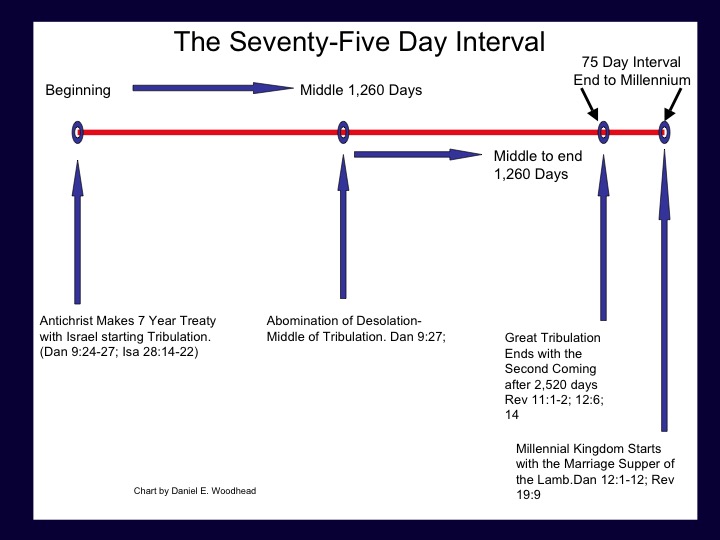
The Millennium (also called the Theocratic Kingdom, or the Messianic Kingdom) does not start right away at the close of the Great Tribulation. Scripture tells us that the duration of the first half of the Great Tribulation is 1,260 days (3 ½ years). This is the length of the time between two significant events. They are the signing of the covenant with Israel by the Antichrist, initiating the Great Tribulation, and the Abomination of Desolation being set up in the Temple, which is the mid point event. Scripture also tells us that the last half of the Tribulation will be 1,260 days counting from the Abomination of Desolation to the demise of the Antichrist. These two sets of 3 ½ years each equal a total of seven years. When comparing several Scripture passages, that reference the Great Tribulation’s duration, another specific time interval is noted. This is a seventy-five day interval at the end of the Great Tribulation and prior to the establishment of the Messianic Kingdom. The interval is described in Daniel, and the differences in numbers are intentional, they are not scribal error:
Daniel 12:11-12 
“11And from the time that the continual burnt-offering shall be taken away, and the abomination that maketh desolate set up, there shall be a thousand and two hundred and ninety days [1290]. 12Blessed is he that waiteth, and cometh to the thousand three hundred and five and thirty days [1335].” (KJV, brackets added)
The Daniel passage gives us two additional figures. The first is 1,290 days, or an additional thirty days, during which time the Abomination of Desolation will remain in the Temple before it is removed. The second figure is 1,335 days, which is another 45 days beyond the 1,290 and 75 days beyond the 1,260 days. A special blessing is pronounced upon those who survive to the 1,335th day. The blessing is, for those who survive, to be able to enter into the Messianic Kingdom. Many will not make it that far, even though they made it to the end of the Tribulation. The events and the time intervals are illustrated on the following chart:
75 Day Interval Chart by Daniel Woodhead
There are nine events that occur during this 75-day period are:
  • The removal of the Abomination of Desolation from the Temple.
  • The final destination of the Antichrist.
  • The final destination of the False Prophet.
  • The binding of Satan.
  • The judgment of the Gentiles.
  • The resurrection of the Old Testament Saints.
  • The resurrection of the Tribulation Saints.
  • The Marriage Feast of the Lamb (this is the formal start of the Millennium)

1. The Removal of the Abomination of Desolation

The pivotal event, which signals the mid-point of the Great Tribulation, is the Antichrist’s takeover of the Jewish Temple. He breaks his covenant with the Jews, and declares himself “The Almighty God” (II Thessalonians 2:4). He also begins a serious persecution of the Jews, which will last for 1,260 days. The False Prophet sets up an inanimate image of the Antichrist in the Temple and Satan, through the False Prophet, causes it to become alive. The Antichrist is in control of the world for those 1,260 days and then he will be killed. The image stays in the Temple for additional thirty days.
Daniel 12:11
“11And from the time that the continual burnt-offering shall be taken away, and the abomination that maketh desolate set up, there shall be a thousand and two hundred and ninety days.” (KJV)
The desecration of the Jewish Temple continues an additional thirty days beyond the end of the Great Tribulation. It will then be destroyed, which brings the Abomination of Desolation to an end. It is not clear why God allows the Abomination of Desolation to remain in the Temple for 30 days after the Great Tribulation ends.

2. The Judgment of the Gentiles

The Olivet Discourse of Jesus to His inner circle of Peter, James, John, and Andrew comes to an end with the Judgment of the Gentiles. Even though a significant number of Gentiles will be killed during the Great Tribulation (and their armies will be slaughtered in the Campaign of Armageddon) some will make it through alive. They will be gathered together for the purpose of a special judgment.
There are two passages of Scripture that give the insight into the Judgment of the Gentiles:
Matthew 25:31-46   
“31When the Son of man shall come in his glory, and all the holy angels with him, then shall he sit upon the throne of his glory: 32And before him shall be gathered all nations:33and he shall separate them one from another, as a shepherd divideth [his] sheep from the goats: And he shall set the sheep on his right hand, but the goats on the left. 34Then shall the King say unto them on his right hand, Come, ye blessed of my Father, inherit the kingdom prepared for you from the foundation of the world: 35For I was an hungred, and ye gave me meat: I was thirsty, and ye gave me drink: I was a stranger, and ye took me in: 36Naked, and ye clothed me: I was sick, and ye visited me: I was in prison, and ye came unto me. 37Then shall the righteous answer him, saying, Lord, when saw we thee an hungred, and fed [thee]? or thirsty, and gave [thee] drink? 38When saw we thee a stranger, and took [thee] in? or naked, and clothed [thee]? 39Or when saw we thee sick, or in prison, and came unto thee? 40And the King shall answer and say unto them, Verily I say unto you, Inasmuch as ye have done [it] unto one of the least of these my brethren, ye have done [it] unto me. 41Then shall he say also unto them on the left hand, Depart from me, ye cursed, into everlasting fire, prepared for the devil and his angels: 42For I was an hungred, and ye gave me no meat: I was thirsty, and ye gave me no drink: 43I was a stranger, and ye took me not in: naked, and ye clothed me not: sick, and in prison, and ye visited me not. 44Then shall they also answer him, saying, Lord, when saw we thee an hungred, or athirst, or a stranger, or naked, or sick, or in prison, and did not minister unto thee? 45Then shall he answer them, saying, Verily I say unto you, Inasmuch as ye did [it] not to one of the least of these, ye did [it] not to me. 46And these shall go away into everlasting punishment: but the righteous into life eternal.” (KJV)
 This passage confirms the timing of the judgment, which will be after the Second Coming of the Messiah, when the Throne of David will be set up as described in verse 31 above.
The place of the judgment is not given in this passage, but the prophet Joel does discuss it:
Joel 3:1-3 
“1For, behold, in those days, and in that time, when I shall bring back the captivity of Judah and Jerusalem, 2I will gather all nations, and will bring them down into the valley of Jehoshaphat; and I will execute judgment upon them there for my people and for my heritage Israel, whom they have scattered among the nations: 3and they have parted my land, and have cast lots for my people, and have given a boy for a harlot, and sold a girl for wine, that they may drink.” (KJV, underlining added)
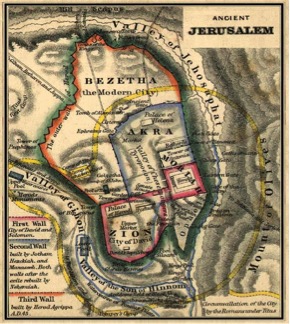
This judgment that will take place just outside the City of Jerusalem, in the Valley of Jehoshaphat, which lies between the city and the Mount of Olives.
Ancient City of Jerusalem and Valley of Jehosaphat.
Source: http://commons.wikimedia.org/wiki/File:Ancient_Jerusalem_Modern_Jerusalem.jpg
Joel also confirms that this judgment is to occur near the time of the restoration of the Nation Israel, which is at the end of the Great Tribulation. All the Gentiles surviving after the war will be gathered into the Valley of Jehoshaphat for the judgment. This is the same place on the east of the Temple Mount next to the Mount of Olives where the final battle took place. The term “Gentiles” is the same as “all nations”. This judgment will be for the purpose of determining their individual final destination of eternal life or eternal hell. Therefore, it is a very serious event. The basis for the judgment will be how they treated the Jews during the Tribulation. The sins cited by Joel include: scattering the Jews in the middle of the Great Tribulation, parting the land during the Campaign of Armageddon, and selling the Jews into slavery (Zechariah 14:1-2).
Each Gentile will be judged on the basis his or her participation in, or refusal to participate in, these actions. The Lord Jesus gave us the results of the judgment during the Olivet Discourse (Matthew 25:31-46). He identifies the judge, the judgment, and those who are judged in Matthew’s gospel:
Matthew 25:31-33
“31When the Son of man shall come in his glory, and all the holy angels with him, then shall he sit upon the throne of his glory: 32And before him shall be gathered all nations: 33and he shall separate them one from another, as a shepherd divideth [his] sheep from the goats: And he shall set the sheep on his right hand, but the goats on the left.” (KJV)

The Judge

Jesus (“Son of man”) is the judge who will sit on a throne in the all His glory in the Valley of Jehoshaphat.

The Judged

The subjects of the judgment are individuals, and not a judgment of nations (verses 32-33). The Greek word for “nations” is ethnos, which is Strong’s #1484, and it means “all those who are not Jews”. In other words it means the Gentiles. The word “nations” is the common term for Gentiles used in the Bible. All the Gentiles who survive the Tribulation, and the Campaign of Armageddon, will be gathered into the Valley of Jehoshaphat, and will then be separated by the Messiah. There are three specific groups mentioned in this passage: the “sheep” Gentiles, the “goat” Gentiles, and the “brethren”. Some Gentiles are brought to His right-hand side and are called “sheep”, and those Gentiles brought to His left-hand side are called “goats”. Note the positional aspect of the decision, being put to the right or left side of Jesus the Judge. The pro-Jewish Gentiles are known as the “sheep” camp and the anti-Jewish Gentiles are known as the “goat” camp. Matthew also discusses the pro-Jewish sheep camp:
Matthew 25:34-40
“34Then shall the King say unto them on his right hand, Come, ye blessed of my Father, inherit the kingdom prepared for you from the foundation of the world: 35For I was an hungred, and ye gave me meat: I was thirsty, and ye gave me drink: I was a stranger, and ye took me in: 36Naked, and ye clothed me: I was sick, and ye visited me: I was in prison, and ye came unto me. 37Then shall the righteous answer him, saying, Lord, when saw we thee an hungred, and fed [thee]? or thirsty, and gave [thee] drink? 38When saw we thee a stranger, and took [thee] in? or naked, and clothed [thee]? 39Or when saw we thee sick, or in prison, and came unto thee? 40And the King shall answer and say unto them, Verily I say unto you, Inasmuch as ye have done [it] unto one of the least of these my brethren, ye have done [it] unto me.” (KJV)

“The Sheep” - Gentiles Helping The Jews

Jesus describes those who helped His “brethren”, the Jews, during the Great Tribulation as “sheep”. Remember, the church had not yet been formed when Christ’s Olivet Discourse was given. Therefore, His usage of the term “brethren” in this context refers to the Jews. These Gentiles will be putting themselves in mortal danger, just as it was during World War II when the Nazis were hunting the Jews and killing those non-Jews who hid or aided them. The Jews will flee into the wilderness without provisions. The pro-Jewish “sheep” will provide them with food, clothing and shelter. They will visit them in prison, and in general show kindness toward them. The result of their judgment is being given permission to enter into the Messianic Kingdom. It is the “sheep” Gentiles who will be involved in the destruction of Babylon (Isaiah 13:1-5). They will be the “resistance fighters” who are instrumental in overthrowing the one-world government that will be headquartered at Babylon.
Some have tried to interpret the term “brethren” as referring to saints in general, but this makes  the passage meaningless. If the “brethren” are saints in general, then who are the “sheep” since they too have eternal life? It would be very confusing to make both the “sheep” and the “brethren” as saints of the same order. From this context alone, it should be very evident that the “brethren” must refer to Jewish people because the saints are the “sheep” and the unsaved are the “goats”. Furthermore, the parallel passage of Joel 3:1-3 makes it certain that these “brethren” are the Jewish people of the Great Tribulation. The term “brethren” here is used in the sense of “brethren in the flesh.” The fact that only Matthew records this segment of the Olivet Discourse also teaches the same truth. Matthew’s gospel was directed at a Jewish audience, and since his is the most “Jewish” of the Gospels, his primary concern has been how the Messiah’s coming will affect the Jewish people.
The “sheep”, which are pro-Jewish, are clearly stated to be the “righteous” ones. Will they be saved because they are pro-Jewish? This cannot be true because that would make their salvation be based on their works, and not the work of God. This passage is an example of James 2:14-26, that distinguishes between perfecting one’s faith through our works, as compared to one who is basing their salvation only on faith without any works. Because these Gentiles are already believers in the Lord Jesus Christ, they will refuse to do the commands of the Antichrist to destroy the Jews. So, while Jews will undergo a great persecution, these believing Gentiles will do what they can to help the Jews under these conditions. A believer will follow Christ’s commandments, and will not follow the Antichrist. Their works toward the Messiah’s “brethren” will prove their faith. They will be allowed to enter into the Messianic Kingdom because they are saved Gentiles, and they will be the ones to populate the Gentile nations during the Messianic Kingdom (vv.34-40).

The “Goats” - Gentiles Who Harmed The Jews

On the other hand, the “goats” will be the anti-Jewish Gentiles who, because of their unbelief in Jesus, will join the ranks of the persecutors under the Antichrist’s authority. They will show their lack of faith by their works. They are the ones who will not be “watching”, “ready” or “laboring”, in violation of the five parables. For this reason they will be left out of the Messianic Kingdom:
Matthew 25:41-45 
41Then shall he say also unto them on the left hand, Depart from me, ye cursed, into everlasting fire, prepared for the devil and his angels: 42For I was an hungred, and ye gave me no meat: I was thirsty, and ye gave me no drink: 43I was a stranger, and ye took me not in: naked, and ye clothed me not: sick, and in prison, and ye visited me not. 44Then shall they also answer him, saying, Lord, when saw we thee an hungred, or athirst, or a stranger, or naked, or sick, or in prison, and did not minister unto thee? 45Then shall he answer them, saying, Verily I say unto you, Inasmuch as ye did [it] not to one of the least of these, ye did [it] not to me.” (KJV)
They will be killed and sent directly to Hell. This judgment is not judging them on works, but whether or not they believed in the Messiah, and sends those who harmed the Jews to Hell.

3. The Antichrist’s Final destination


Revelation 19:20 makes is quite clear the Antichrist will meet his final demise:
Revelation 19:20
“20And the beast was taken, and with him the false prophet that wrought miracles before him, with which he deceived them that had received the mark of the beast, and them that worshipped his image. These both were cast alive into a lake of fire burning with brimstone.” (KJV)
The text states that the Antichrist will be “cast alive” into the Lake of Fire. The Antichrist is killed at the end of the Great Tribulation and while his body will not be buried, his soul will be in Hell (Habakkuk 3:13b; II Thessalonians 2:8; Isaiah14:3-11; 16-21). As armed forces of the Antichrist flee Christ’s slaughter, his body will be trampled under their feet (Isaiah 14:19-21). So if the text states that he will be “cast alive into a lake of fire”, he must come back to life in order for that to occur. There is the Second Resurrection and it only applies to the resurrection of the damned (those who did not accept Christ when they had the opportunity), which like the First Resurrection also comes in stages. Jesus, the second person of the Holy Trinity, is the “first fruits” of the First Resurrection. Interestingly, the Antichrist will be the “first fruits” of the Second Resurrection. The result of his resurrection will end with his eternal destiny in the Lake of Fire.

3a. The Lake of Fire

The “lake of fire burning with brimstone” is that which Christ referred as Gehenna, and is also called the Lake of Fire (Matthew 5:22, 29-30, 10:28, 18:9, 23:15, 33; Mark 9:43, 45, 47; Luke 12:5). The Greek work for the Lake of Fire is Gehenna, and is named for the Valley of Hinnom just south of Jerusalem. It was at this site that the Jews offered their children to god Molech (II Kings 23:10; Jeremiah 7:31; 19:2-6). In later times it served as a continually burning garbage dump, and therefore provided the imagery that the Bible uses to describe the place of everlasting punishment. The Lake of Fire is where all those who do not believe in Christ will reside forever. The Lake of Fire is where the contents of Hell will be deposited. Hell is a place of a spiritual punishment. The Lake of Fire will be a place of punishment for the resurrected bodies of the unbelievers and their spirits. Being thrown into the Lake of Fire is the Second Death, and is the final destination of the wicked.

3b. The False Prophet

According to Revelation 19:20 the False Prophet will have a counterfeit gift of performing miracles for the sole purpose of deceiving the world so that they worship the Antichrist (beast) and take his mark of 666.
Revelation 19:20
“20And the beast was taken, and with him the false prophet that wrought miracles before him, with which he deceived them that had received the mark of the beast, and them that worshipped his image. These both were cast alive into a lake of fire burning with brimstone.” (KJV)
He will be “cast alive” into the Lake of Fire along with the Antichrist. These two members of the “unholy trinity” (the Antichrist masquerading as the counterfeit “son”, and the false prophet masquerading as the counterfeit “holy spirit”) will the only occupants for the first 1,000 years that the Lake of Fire will be operational. What a appropriate destiny for the two men who instituted Hell on earth for seven years!

4a. Satan’s Binding

Satan, who masquerades as the counterfeit father in the “unholy trinity”, will be cast into the abyss.
Revelation 20:1-3
“1And I saw an angel come down from heaven, having the key of the bottomless pit and a great chain in his hand. 2And he laid hold on the dragon, that old serpent, which is the Devil, and Satan, and bound him a thousand years, 3And cast him into the bottomless pit, and shut him up, and set a seal upon him, that he should deceive the nations no more, till the thousand years should be fulfilled: and after that he must be loosed a little season.” (KJV)
Here we see the binding of Satan, who was cherub and of the highest order of celestial beings in Heaven. The one who does the binding is a common angel, who is the lowest order of celestial beings in Heaven. How fitting for Satan who was the highest of the highest rank of celestial beings to be bound by one from the lowest rank! Satan will be bound for 1,000 years, which is the duration of the Millennial Kingdom on earth. He will no longer be free to be the great deceiver of mankind. He will reside in the Abyss. The binding is done with the promise that Satan will be released for a short time to again test mankind at least one more time.

4b. The Abyss

The New Testament tells us that this is the temporary dwelling place of the imprisoned demons (Revelation 9:1-21). In classical Greek it is the adjective abussos. It refers to an “unfathomable or boundlessly deep place”. Many of the demons that Jesus expelled from the earth were committed to the abyss. They dreaded going there before their appointed time (Luke 8:31). Millions of them will be let loosed during the Great Tribulation in two separate invasions to wreck havoc on the earth. At this time they begin to appear so the human population can see them. Up until this time, when the fifth and sixth trumpets are sounded, the demonic world is unseen to the human eye (Revelation 9).

5. The First Resurrection

The first resurrection involves only believers and it is found in Revelation 20:
“Revelation 20:5-6
 5But the rest of the dead lived not again until the thousand years were finished. This is the first resurrection. 6Blessed and holy is he that hath part in the first resurrection: on such the second death hath no power, but they shall be priests of God and of Christ, and shall reign with him a thousand years.” (KJV)
According to verse five, the resurrection of the Great Tribulation saints completes the First Resurrection. It is separated from the Second Resurrection by one thousand years. The whole point of verse six states that the First Resurrection involves only believers, and that is why it is a “blessed” event for those who participate in it.
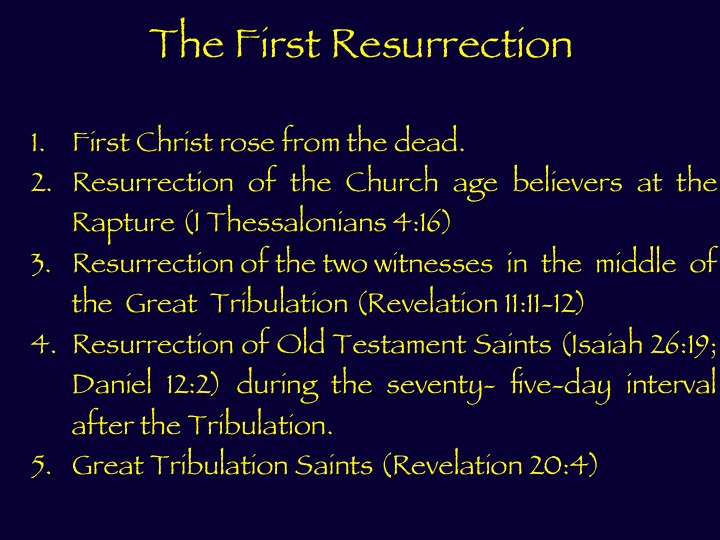
It is important for us to realize that the First Resurrection is not a general resurrection of all the dead at one time. The Bible teaches in 1 Corinthians 15: 20-23 that it is an orderly sequence and occurs in the five stages:
1 Corinthians 15:20-23
“20But now is Christ risen from the dead, and become the first fruits of them that slept. 21For since by man came death, by man came also the resurrection of the dead. 22For as in Adam all die, even so in Christ shall all be made alive. 23But every man in his own order: Christ the first fruits; afterward they that are Christ's at his coming.” (KJV)
This shows that all of the Christians shall live again, or be resurrected, and that there is an orderly progression to the stages of this resurrection. After declaring that a resurrection of the righteous will occur in verse 23, Paul states that the righteous will be resurrected each “in his own order”. The word “order” is a military term used to describe the orderly procession of troops marching to battle (in Greek it is tagma). It always refers to an orderly procession such as the movement of troops, or an orderly procession of the priests in the Old Testament. The central point of this passage is that there is an orderly, and sequential process, to the first resurrection, and includes these five stages:
The First Resurrection Stages

6. The Resurrection of Old Testament Saints

We must keep in mind that the Rapture only includes the Church, that is, those who have accepted Jesus of Nazareth and confessed His name before other men on this earth:
Romans 10:9
 “9That if thou shalt confess with thy mouth the Lord Jesus, and shalt believe in thine heart that God hath raised him from the dead, thou shalt be saved.” (KJV)
 This verse, along with many others, further refines and gives explicit instruction in how to actualize our faith. We must tell others what has taken place in our hearts. It is similar to being obedient, and carrying out the commandment to be baptized. Both are outward signs attesting to the transformation that the Lord has brought about within us. So those, who have done this prior to the Great Tribulation, will have already gone up to Heaven to meet the Lord in the air at the time of the Rapture (I Thessalonians 4:16-17).
The following two passages speak about believers from the Old Testament times who loved God, and who were waiting for His coming in the flesh. However, they died prior to Christ appearing on the planet. This is not to say they kept the Law, it means that they believed God and took Him at His Word. The Old Testament saints were the righteous ones waiting for the Lord’s appearing, like Simeon was in Luke 2:25. They will be rewarded for their belief:
Isaiah 26:19
“19Thy dead shall live; my dead bodies shall arise. Awake and sing, ye that dwell in the dust; for thy dew is as the dew of herbs, and the earth shall cast forth the dead.” (KJV)
This passage states that the Old Testament saints were guaranteed a resurrection, but it does not say when. Other verses bring the concept into clearer focus for us:
Daniel 12:2
 “2And many of them that sleep in the dust of the earth shall awake, some to shame [and] everlasting contempt.” (KJV)
This passage draws a very clear distinction between the righteous and the unrighteous. Within the context of the twelfth chapter of Daniel, this verse is speaking of a particular time at the “end.” It is addressed to the Jews who are identified as “your people” (Daniel 12:1). Only the righteous will be resurrected at this time to partake in the blessing of the Millennial Kingdom. These are also known as “the friends of the bridegroom” spoken of by John the Baptist (John 3:29). Since the context of Daniel chapter twelve is speaking of the events after the Great Tribulation, it is at that time that the Old Testament saints will be resurrected.

7. The Resurrection of Tribulation Saints

There will also be a resurrection of those saints who became believers and were killed during the Great Tribulation. Revelation 20:4 tells us the facts surrounding this event:
Revelation 20:4
 “4And I saw thrones, and they sat upon them, and judgment was given unto them: and [I saw] the souls of them that were beheaded for the witness of Jesus, and for the word of God, and which had not worshipped the beast, neither his image, neither had received [his] mark upon their foreheads, or in their hands; and they lived and reigned with Christ a thousand years.” (KJV)
Here the apostle John sees two groups of people co-reigning with the Lord Jesus. The first group is those who already had received their judgment for their works from Christ. The judgment, called the Bema Seat Judgment, is referenced in Romans 14:10 and 2 Corinthians 5:10. This will be the Church age saints who are resurrected at the Rapture of the Church. They receive the judgment of their works, and their rewards, right after they enter Heaven from Christ (1 Corinthians 3).
The second group is identified as those souls who have been beheaded for the testimony of Jesus. They were beheaded because they would not worship the Antichrist, nor would they consent to receive the mark of the Beast (666). These are the Tribulation saints. They go into the Millennial Kingdom with Christ.

8.  The Marriage Feast of the Lamb

In the ancient Jewish wedding, the wedding feast was the last of four stages. The four stages of the ancient Jewish wedding are reflected in the events planned long ago by God the Father:
  • The Father of the Groom made the arrangement for the Bride and paid the bride price. In this case the price was the blood of Jesus (Ephesians 5:25-29).
  • The fetching of the Bride is when she is ready and waiting to be escorted by her Bridegroom to the home of his father. This is comparable to the Rapture of the Church (I Thessalonians 4:13-18).
  • The marriage ceremony of the Bride to the Groom, or when the Church weds the Messiah happens immediately after arriving at his father’s house (Church age saints are now in Heaven with Christ) (Revelation 19:6-8).
  • The wedding, or marriage feast, is the last event of the sequence and lasts for seven days. The Marriage Feast of the Lamb is the event that begins the Messianic Kingdom.
The Church is the bride and is married to Christ in Heaven after the Rapture. The First Resurrection brings the Old Testament saints, who are the friends of the bridegroom, and the Great Tribulation saints, who are also invitees, to complete the invited “guest list” to the wedding, and now the wedding feast can take place. The invitation has already been issued:
Revelation 19:9 
“9And he saith unto me, Write, Blessed are they which are called unto the marriage supper of the Lamb. And he saith unto me, These are the true sayings of God.” (KJV)
 The result of this invitation is the First Resurrection to be followed by the wedding feast, which will last for seven days. Christ spoke of this during the Last Supper as He raised His glass of wine with His apostles:
Matthew 26:27
 “27And he took the cup, and gave thanks, and gave it to them, saying, Drink ye all of it; For this is my blood of the new testament, which is shed for many for the remission of sins. But I say unto you, I will not drink henceforth of this fruit of the vine, until that day when I drink it new with you in my Father's kingdom.” (KJV)
This event concludes the seventy-five day interval and inaugurates the Millennium. The wedding feast parable told by The Messiah is connected with the Kingdom:
Matthew 22:1-14
“1And Jesus answered and spake unto them again by parables, and said, 2The kingdom of heaven is like unto a certain king, which made a marriage for his son, 3And sent forth his servants to call them that were bidden to the wedding: and they would not come. 4Again, he sent forth other servants, saying, Tell them which are bidden, Behold, I have prepared my dinner: my oxen and my fatlings are killed, and all things are ready: come unto the marriage. 5But they made light of it, and went their ways, one to his farm, another to his merchandise: 6And the remnant took his servants, and entreated them spitefully, and slew them. 7But when the king heard thereof, he was wroth: and he sent forth his armies, and destroyed those murderers, and burned up their city. 8Then saith he to his servants, The wedding is ready, but they which were bidden were not worthy. 9Go ye therefore into the highways, and as many as ye shall find, bid to the marriage. 10So those servants went out into the highways, and gathered together all as many as they found, both bad and good: and the wedding was furnished with guests. 11And when the king came in to see the guests, he saw there a man which had not on a wedding garment: 12And he saith unto him, Friend, how camest thou in hither not having a wedding garment? And he was speechless. 13Then said the king to the servants, Bind him hand and foot, and take him away, and cast him into outer darkness, there shall be weeping and gnashing of teeth. 14For many are called, but few are chosen.”(KJV)
The main point of this parable is that those who were originally invited to the wedding feast, the Pharisees and the Jewish generation of Jesus’ day, will not partake of the feast or enter into the Messianic Kingdom. This is because they committed the unpardonable sin of attributing the works of God to Satan (“made light of it”). This is also known as “blaspheming the Holy Spirit” (Mark 3:29) The Jews of the Tribulation period will be at the supper and enter into the Kingdom. All unbelievers will be cast “into outer darkness” and will be excluded from entering the Messianic Kingdom:
Matthew 25:1-13
“1Then shall the kingdom of heaven be likened unto ten virgins, which took their lamps, and went forth to meet the bridegroom. 2And five of them were wise, and five were foolish. 3They that were foolish took their lamps, and took no oil with them: 4But the wise took oil in their vessels with their lamps. 5While the bridegroom tarried, they all slumbered and slept. 6And at midnight there was a cry made, Behold, the bridegroom cometh; go ye out to meet him. 7Then all those virgins arose, and trimmed their lamps. 8And the foolish said unto the wise, Give us of your oil; for our lamps are gone out. 9But the wise answered, saying, Not so; lest there be not enough for us and you: but go ye rather to them that sell, and buy for yourselves. 10And while they went to buy, the bridegroom came; and they that were ready went in with him to the marriage: and the door was shut. 11Afterward came also the other virgins, saying, Lord, Lord, open to us. 12But he answered and said, Verily I say unto you, I know you not. 13Watch therefore, for ye know neither the day nor the hour wherein the Son of man cometh.”(KJV) 
The contrast that Christ speaks of here is not between two types of believers, but between believers and unbelievers. The “wise” virgins are the believers and they have oil, which is a symbol of the Holy Spirit, while the “foolish” virgins have no oil at all. They had not been prepared through belief. Some think there is plenty of time before they have to commit their lives to Christ, or they just do not want to believe that there is a God. We never know the day or the hour when He will come. The “foolish” ones were excluded from the wedding feast and from ever going in to the Messianic Kingdom. That is why they are “foolish”:
Psalm 53:1a
“1The fool hath said in his heart, [There is] no God. Corrupt are they, and have done abominable iniquity…” (KJV)
Isaiah also connects a feast with the Kingdom and a resurrection of the dead:
Isaiah 25:6-8
“6And in this mountain will Jehovah of hosts make unto all peoples a feast of fat things, a feast of wines on the lees, of fat things full of marrow, of wines on the lees well refined. 7And he will destroy in this mountain the face of the covering that covereth all peoples, and the veil that is spread over all nations. 8He hath swallowed up death for ever; and the Lord Jehovah will wipe away tears from off all faces; and the reproach of his people will he take away from off all the earth: for Jehovah hath spoken it” (KJV)
So the Great Tribulation has ended, and the final events have been accomplished during the seventy-five day interval. This concludes with the Marriage feast of the Lamb Jesus who welcomes all believers into His Kingdom.

Daniel E. Woodhead

Bibliography:
Fruchtenbaum, Arnold G. The Footsteps of the Messiah: A Study of the Sequence of Prophetic Events. San Antonio, TX: Ariel Ministries. 2004.
Pentecost, J. Dwight. Things to Come. Grand Rapids, MI: Zondervan Publishing House. 1958.
Gabelein Arno C. Gabelein’s Concise Commentary on the Whole Bible. Neptune, NJ: Loizeauz Brothers. 1970.
Peters, George H. H. The Theocratic Kingdom in Three Volumes. Grand Rapids, MI: Kregel Publication. 1952.
Unger, Merrill F. Great Neglected Bible Prophecies. Chicago, IL: Scripture Press Book Division. 1955.
Walvoord, John F. Daniel The Key to Prophetic Revelation. Chicago: The Moody Bible Institute. 1971.