All Israel will Be Saved
Romans 11:25-26
25 For I would not, brethren, that ye should be ignorant of this mystery, lest ye should be wise in your own conceits; that blindness in part is happened to Israel, until the fulness of the Gentiles be come in. 26 And so all Israel shall be saved: as it is written, There shall come out of Sion the Deliverer, and shall turn away ungodliness from Jacob (KJV):
Their Salvation Will Come After The Great Tribulation
All Nations Will Come Against Jerusalem
Zechariah 12:1-8 actually describes a battle that is the fifth of eight stages that comprise the Campaign of Armageddon. This takes place in the future and begins with the sixth bowl judgment during the middle of The Great Tribulation (Revelation 16:12-16
Jerusalem Will be a Cup of Reeling
Zechariah 12:1-3
1 The burden of the word of Jehovah concerning Israel. Thus saith Jehovah, who stretcheth forth the heavens, and layeth the foundation of the earth, and formeth the spirit of man within him: 2behold, I will make Jerusalem a cup of reeling unto all the peoples round about, and upon Judah also shall it be in the siege against Jerusalem. 3And it shall come to pass in that day, that I will make Jerusalem a burdensome stone for all the peoples; all that burden themselves with it shall be sore wounded; and all the nations of the earth shall be gathered together against it (ASV, 1901).
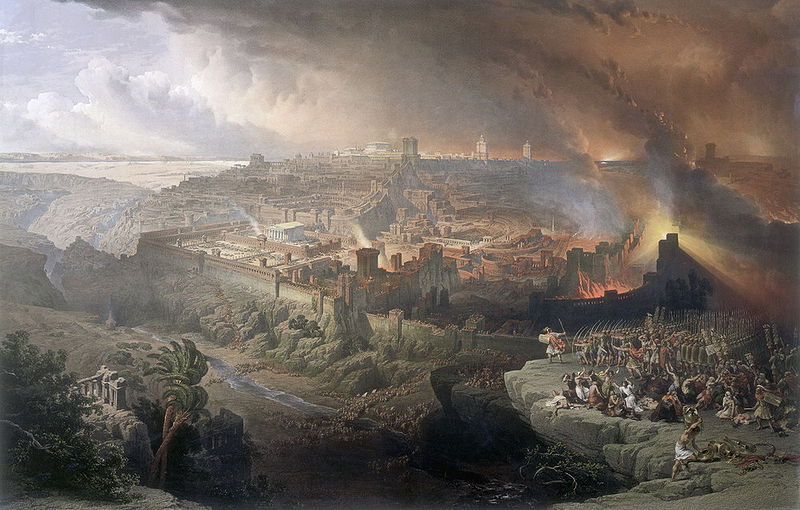
- Roman Destruction of Jerusalem by David Roberts Cir 1850
God begins this oracle by stating that this particular message that is about to be delivered is heavy, or a “burden” (in Hebrew massa). That is, it is important and burdensome to be given, and to be heard. It is not pleasant but must be heeded in the same seriousness in which it was given. This is the second such massa in this book. The first encompassed chapter 9:1 through chapter 11:17. The first one graphically depicted Israel’s rejection of her Messiah and the rise of the worthless shepherd, which will be the Antichrist. His rise to power must precede Israel’s deliverance. God will use him to plunge the Nation Israel into its most severe time of testing foreseen by the prophet Jeremiah as the “Time of Jacob’s Trouble,” (Jeremiah 30:5-7). The prophet Daniel was given a revelation regarding this time as well; he recorded, “And at that time shall Michael stand up, the great prince who standeth for the children of thy people; and there shall be a time of trouble, such as never was since there was a nation even to that same time: and at that time thy people shall be delivered, every one that shall be found written in the book” (Daniel 12:1). Daniel finished this verse by stating that the Jews will be delivered.
God then goes on to describe the attitude of Jerusalem’s enemies. Jerusalem is the capital city of Israel and will be the future capital of the world in Christ’s Millennial reign. The characterization of Jerusalem as the Nation Israel seems to align with the grammatical technique of “merism”, where one name stands for all of a particular subject. In this case it is the capital city representing all of Israel. In Zechariah 11:2 God says Jerusalem will become “a cup of reeling.” (It is called a “cup of trembling” in the King James translation.) “A cup of reeling” means a cup filled with an intoxicating drink that will cause anyone who drinks it to reel or stagger. This particular siege takes place in the future when all nations come against Jerusalem in battle. Further He uses the term “burdensome stone” in His description of Jerusalem to give the reader the sense of lifting a very heavy stone. It will cause grievous injuries to those who try and lift it. The divine penalty for the nations that try and lift this stone (Jerusalem) is that they will suffer sprains or dislocation and tear themselves to pieces.
God Confounds The Invaders
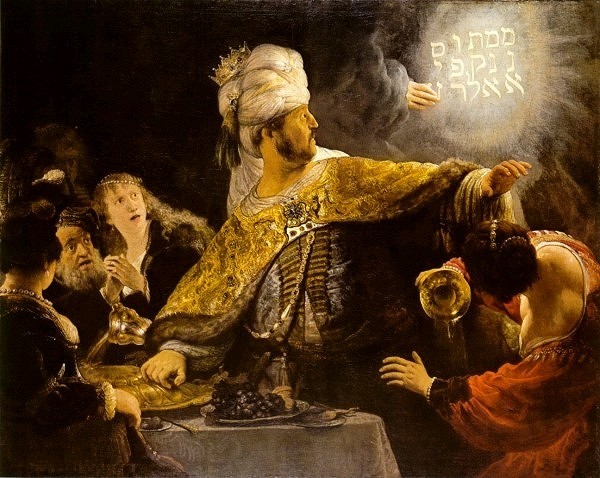
- Belshazzar's Feast by Rembrandt cir. 1635
Zechariah 12:4
4In that day, saith Jehovah, I will smite every horse with terror, and his rider with madness; and I will open mine eyes upon the house of Judah, and will smite every horse of the peoples with blindness (ASV, 1901).
All this will happen as the text says “in that day” (Hebrew bayyom hahu). “In that day” refers to the particular time period called the “latter days” or “end of days”. This is the same as the “Day of the Lord” or the “Great Tribulation”. It is important to note that the text says, “and all the nations of the earth shall be gathered together against it.” Bearing in mind this prophecy was given in 485 B.C., it was inconceivable that there could be a conflict that engaged the entire world. 135 countries took part in World War I, and more than 15,000,000 people died in the war.[1] World War II, which began shortly after on September 1, 1939, was the second time a large number of nations gathered to battle and this time more that 80,000,000 perished or about 2.5 % of the world’s population.[2] Now that these massive conflicts have occurred it is no longer difficult to accept God’s Word stating that, “and all the nations of the earth shall be gathered together against it.”
During the invasion of Jerusalem God will cause the all the military forces coming against Jerusalem to be filled with terror and blindness. His love for the Jewish people is evident as He says, “and I will open mine eyes upon the house of Judah.” Their enemies will be rendered useless for achieving their goal, which is the destruction of Israel and particularly Jerusalem. The normally brave enemies will suffer chaotic frenzy and they will not be able to see out of their vehicles.
The Jewish Leaders and The People React
Zechariah 12:5-7
5And the chieftains of Judah shall say in their heart, The inhabitants of Jerusalem are my strength in Jehovah of hosts their God. 6In that day will I make the chieftains of Judah like a pan of fire among wood, and like a flaming torch among sheaves; and they shall devour all the peoples round about, on the right hand and on the left; and they of Jerusalem shall yet again dwell in their own place, even in Jerusalem. 7Jehovah also shall save the tents of Judah first, that the glory of the house of David and the glory of the inhabitants of Jerusalem be not magnified above Judah (ASV, 1901).
This verse verifies the change of heart the Jewish leaders will have toward God as the battle rages against Jerusalem. For once they will see what He has done to the invaders for them and they begin to turn to Him. The true strength of the inhabitants of Jerusalem is the Lord of the armies, their God. In verse 6 the unique imagery of a strong fire is used by God when He says, the “chieftains of Judah like a pan of fire among wood, and like a flaming torch among sheaves; and they shall devour all the peoples round about”. God will now use them to defeat their foes because of their faith. Finally God says that He will save the Jews who live outside the walls of Jerusalem. He separates them out for special protection first when He says, “Jehovah also shall save the tents of Judah first,” Then He will protect those inside the walls so that two segments of the population will receive equal protection and blessing.
Inhabitants of Jerusalem Receive Supernatural Strength
Zechariah 12:8
8In that day shall Jehovah defend the inhabitants of Jerusalem: and he that is feeble among them at that day shall be as David; and the house of David shall be as God, as the angel of Jehovah before them (ASV, 1901).
God now describes the level of protection He will give to the Jews living in Jerusalem during this battle. He is the defender of Jerusalem to be sure but the strength He will impart to the Jews is supernatural. The Jews will have a marvelous strength to fight the invaders. The weakest of the population will become as strong as their warrior King David. The strong ones, designated as “the house of David” or the household or family of David, are to be like God meaning they will be superhuman beings. They will be like the angel of Jehovah who goes before Israel. The point in making this comparison is that all of Israel will receive supernatural strength from the weakest members to the strongest of the population.
Destruction of All Nations That Come Against Israel
Zechariah 12:9
9And it shall come to pass in that day, that I will seek to destroy all the nations that come against Jerusalem (ASV, 1901).
The national regeneration of the Nation Israel is tied to the destruction of Babylon, which will be the world headquarters of the Antichrist (Jeremiah 50:43). Every Jew will become strengthened to fight the enemy as the Lord is incapacitating the foes with blindness and mental panic, and the Nation Israel will prevail.
The National Mourning Begins
Zechariah 12:10
10And I will pour upon the house of David, and upon the inhabitants of Jerusalem, the spirit of grace and of supplication; and they shall look unto me whom they have pierced; and they shall mourn for him, as one mourneth for his only son, and shall be in bitterness for him, as one that is in bitterness for his first-born (ASV, 1901).
Then the Lord pours out His “spirit of grace and of supplication” which causes the Jews to realize that it was them who persecuted Jesus and had Him nailed to the cross at Calvary. The Lord in the first person (“me”) begins to describe the mourning process the Jews will go through when they finally realize that it was God Himself who died for them as Jesus the Messiah. He uses the analogy of losing a child to express the degree of mourning that will be felt. This degree of mourning is unparalleled in the lives of humans because the loss of a child is one of the greatest pains one can experience. He says not only is it the loss of a child, but it is as if it is the parent’s only male child and further defines the situation as losing a son who is their first-born child. Our first-born children are the ones with whom we learn parenting and spend the most time and effort attending to their care. We usually invest more of ourselves into the first-born child than any other child. A loss of this child will give us an immense amount of pain that will never leave us while we are still on this earth. This is the extent of pain the Nation Israel will experience when they finally realize what they have done to their Messiah Jesus.
Example of Previous Mourning
- Nazi Yellow Star Pined on Jews

Zechariah 12:11
11In that day shall there be a great mourning in Jerusalem, as the mourning of Hadadrimmon in the valley of Megiddon (ASV, 1901).
The extent of the mourning that the Jews will have over their treatment of Jesus is likened to the mourning the nation had when Josiah died. “Hadadrimmon” was a city near Jezreel. It was in the plains of Megiddon where Pharaoh Necho II fatally wounded the good king Josiah, one of the few kings of the Southern Kingdom (Judah) that honored God. He started to reign when he was only eight years old and reigned for thirty-one years in Jerusalem. At the age of sixteen he began to pray earnestly seeking the Lord God. As a result of his relationship with God he began to remove the occultist’s symbols from Jerusalem and forbade their sexual sins. At the age of twenty-six he sent several of his advisors and confidants to repair the Temple. During the repair work, the books of Moses (first five books of the Bible) were found, and taken to the king. When Josiah read them he expressed deep sorrow and realized how angry God was with the Nation Israel for not keeping His Word. He then started worship services again in the Temple. Josiah removed all the abominations in the kingdom and caused all the children to turn to their God. His death and the national mourning are recorded in II Chronicles:
II Chronicles 35:20-25
20After all this, when Josiah had prepared the temple, Neco king of Egypt went up to fight against Carchemish by the Euphrates: and Josiah went out against him. 21But he sent ambassadors to him, saying, What have I to do with thee, thou king of Judah? I come not against thee this day, but against the house wherewith I have war; and God hath commanded me to make haste: forbear thee from meddling with God, who is with me, that he destroy thee not. 22Nevertheless Josiah would not turn his face from him, but disguised himself, that he might fight with him, and hearkened not unto the words of Neco from the mouth of God, and came to fight in the valley of Megiddo. 23And the archers shot at king Josiah; and the king said to his servants, Have me away; for I am sore wounded. 24So his servants took him out of the chariot, and put him in the second chariot that he had, and brought him to Jerusalem; and he died, and was buried in the sepulchres of his fathers. And all Judah and Jerusalem mourned for Josiah. 25And Jeremiah lamented for Josiah: and all the singing men and singing women spake of Josiah in their lamentations unto this day; and they made them an ordinance in Israel: and, behold, they are written in the lamentations (ASV 1901, emphasis added).
Israel Mourns for Jesus
Zechariah 12:12-14
12And the land shall mourn, every family apart; the family of the house of David apart, and their wives apart; the family of the house of Nathan apart, and their wives apart; 13the family of the house of Levi apart, and their wives apart; the family of the Shimeites apart, and their wives apart; 14all the families that remain, every family apart, and their wives apart (ASV, 1901).
These verses describe the extent of the mourning in every family from the leaders of the government and the Temple down to the general population. All will mourn in national repentance for the way they rejected the Lord Jesus when He came the first time.
The Cleansing of Sin from Israel
Zechariah 13:1-6
1 In that day there shall be a fountain opened to the house of David and to the inhabitants of Jerusalem, for sin and for uncleanness (ASV, 1901).
“In that day” means this is a revelation from the God about the events during Israel’s future salvation as a nation. Israel had been guilty of the rejection of their Savior and had been suffering a substantial amount of guilt over this. Their hardness of heart was keeping them from national belief in the truth of Jesus. Earlier in the text of chapter twelve Israel, as an entire nation from the highest elected officials and the Temple guardians down to the common citizens, realized that their ancestors had caused the death of their Messiah Jesus. They are also guilty of perpetuating this lie. All at once, in one day, those whom the Lord has chosen will be “born again” together. As the text says, “there shall be a fountain opened.” The Hebrew word used here for “fountain” is maqor. Here it is referring to a substantial amount of blessing, which God Himself will pour out on “the house of David, and to the inhabitants of Jerusalem”. His blessing will essentially gush forth to all Israel (Romans 11:26). We see the same usage of “fountain” used in Psalm 36:9: “For with Thee is the fountain of life”; and in Jeremiah 2:13 and 17:13 it is used as the figure of Jehovah Himself, “the Fountain of living waters.”
It is clearly used here to illustrate the abundance of God’s blessings pouring out to remove sin and impurity from the nation Israel. Not only will the purification cover bodily defilement from abominable practices (such as drug and sexual abuse) but moral and the spiritual defilement of idolatry as well. The blessed fountain is none other that our Lord the Jewish Messiah Jesus. On
the day that our Lord was crucified, God’s fountain was opened for all to see and receive it’s blessing. At the Second Coming of Christ the Nation Israel will finally partake in that fountain and finally all Israel’s spiritual regeneration will occur (Jeremiah 31:31–37; Ezekiel 36:25–32; Romans 11:26–27).
Removing Idolatry and False Prophets from Israel
- Adoration of the Golden Calf by Nicholas Poussin Cir.1594-1665
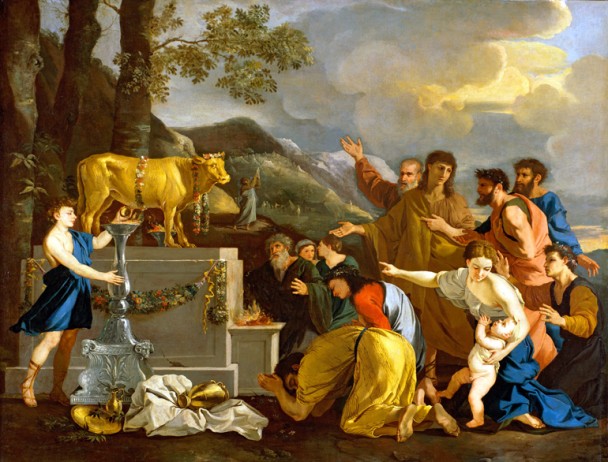
Zechariah 13:2
2And it shall come to pass in that day, saith Jehovah of hosts, that I will cut off the names of the idols out of the land, and they shall no more be remembered; and also I will cause the prophets and the unclean spirit to pass out of the land (ASV, 1901).
When God pours out His Spirit upon the Israelites they will immediately realize that the false prophets and their idols are an anathema and God will cause them to be removed from Israel. False prophets lie, and typically promised peace when there was no peace to be had (Jeremiah 6:13-14; 8:11; 14:3; 23:17; 27:14 28:2, 11; Ezekiel 13:10; Zechariah 13:3; Micah 3:5). They deceive the people with their dreams and their visions were drawn out of their own demonically fed hearts (Jeremiah 14:14; 23:16; 29:8; Ezekiel 13:2-3 ; 22:28 ). They prophesy by the alleged authority of pagan gods such as Baal, and threaten the lives of the true prophets (Jeremiah 2:8; 23:13; 26:7). The false prophets gave the people what they wanted to hear and "whitewashed" over every situation, no matter how perverse it appeared (Ezekiel 13:10-12,14-15; 22:28).
The Foundation for False Prophecy
Some false prophets used magic others appeared to use divination, soothsaying, witchcraft, necromancy, and sorcery, which were all forbidden arts and practices in the Mosaic Law (Ezekiel 13:17-23). Deuteronomy says:
Deuteronomy 13:1-5
1 If there arise in the midst of thee a prophet, or a dreamer of dreams, and he give thee a sign or a wonder, 2and the sign or the wonder come to pass, whereof he spake unto thee, saying, Let us go after other gods, which thou hast not known, and let us serve them; 3thou shalt not hearken unto the words of that prophet, or unto that dreamer of dreams: for Jehovah your God proveth (is testing) you, to know whether ye love Jehovah your God with all your heart and with all your soul. 4Ye shall walk after Jehovah your God, and fear him, and keep his commandments, and obey his voice, and ye shall serve him, and cleave unto him (ASV, 1901).
Deuteronomy 18:15-22
15Jehovah thy God will raise up unto thee a prophet from the midst of thee, of thy brethren, like unto me; unto him ye shall hearken; 16according to all that thou desiredst of Jehovah thy God in Horeb in the day of the assembly, saying, Let me not hear again the voice of Jehovah my God, neither let me see this great fire any more, that I die not. 17And Jehovah said unto me, They have well said that which they have spoken. 18I will raise them up a prophet from among their brethren, like unto thee; and I will put my words in his mouth, and he shall speak unto them all that I shall command him. 19And it shall come to pass, that whosoever will not hearken unto my words, which he shall speak in my name, I will require it of him. 20But the prophet, that shall speak a word presumptuously in my name, which I have not commanded him to speak, or that shall speak in the name of other gods, that same prophet shall die. 21And if thou say in thy heart, How shall we know the word which Jehovah hath not spoken? 22when a prophet speaketh in the name of Jehovah, if the thing follow not, nor come to pass, that is the thing which Jehovah hath not spoken: the prophet hath spoken it presumptuously, thou shalt not be afraid of him (ASV, 1901).
These two sections from Deuteronomy contain at least seven commands regarding prophets:
- Israelites must leave a prophet quickly if he does a sign or a wonder that actually occurs, and at the same time he encourages a belief in other gods.
- Israelites must realize God tests us as to whether we love Him or act according to false prophets.
- Israelites must serve the true God (called here “Jehovah”).
- Israelites must believe that there was a succession of God’s prophets after Moses, then Lord God will rise up a prophet in the midst of Israel that will be as He is, and this will be Jesus the Messiah.
- Israelites must believe the prophets of God will be speaking God’s Word.
- Israelites are not to be afraid of a false prophet if he rose in the midst of the Israelites.
- Israelites must put false prophets to death.
In the Church Age we do not have the legal ability to rid ourselves of false prophets through death. This is because Christianity is not a nation as Israel is; Christians live in every nation on earth. However, we can test what they say by comparing it to Scripture. If what they tell us to do is not Scriptural, we must not listen to them. We are to call them out as false prophets, and do not fear them. If they are the leaders in a particular fellowship we are in, then we must leave it. It is a test of obedience to God. We have the example of the Bereans of Acts 17:11 to provide us with guidance, which says to always test what a prophet, pastor, or teacher says against Scripture. Make sure they live their life in accordance with their teaching (Matthew 7:15-16). Some examples of modern day false prophets are those who:
- Engage in legalism, which is making non-biblical rules binding for salvation and or sanctification.
- Set dates for Christ’s return.
- Encourage immoral behavior, including abortion and sexual deviancy.
- Encourage fellowship with religious groups that do not hold to the inerrancy of Scripture.
- Follow after the occult and occultic groups.
- Deny the deity of Christ.
- Deny the Second Coming.
- Deny the virgin birth.
- Deny the authority of the Bible.
- Deny the substitionary atonement.
We must not be unequally yoked together with them and we must separate from them (II Corinthians 6:14). Separation is not an optional part of Christianity; it is a commandment (Romans 16:17-18; II Cor. 6:14-17; I Timothy 6:5; II Timothy 2:16-18; 3:5; Titus 3:10; 2 John 7-11; Revelation 18:4). Separation is not mean or unloving; it is obedience to God. Look at the verbs used in these passages:
- “Mark them . . . avoid them” (Romans 16:17, KJV)
- “Be ye not unequally yoked together with unbelievers…” (II
Corinthians 6:14, KJV)
- “Come out from among” (II Corinthians 6:17, KJV)
- “Have no fellowship with” (Ephesians 5:11, KJV)
- “Withdraw yourself from every brother that walketh disorderly” (II Thessalonians 3:6, KJV)
- “Withdraw thyself” (I Timothy 6:5, KJV)
- “Shun” (II Timothy 2:16, KJV)
- “Purge himself from” (II Timothy 2:21, KJV)
- “From such turn away” (II Timothy 3:5, KJV)
- “Reject” (Titus 3:10, KJV)
- “Receive them not into your house neither bid them God speed” (II John 1:10 KJV)
Separation provides a wall of protection against spiritual danger. Failure to separate as commanded leaves one open to the influence of error (I Corinthians 15:33). The reason a shepherd separates the sheep from wolves is to protect them. Likewise, a faithful and godly Bible teacher will seek to separate his flock from spiritual dangers that are even more destructive than wolves.
God Deals With the False Prophets of Israel
Zechariah 13:3-4
3And it shall come to pass that, when any shall yet prophesy, then his father and his mother that begat him shall say unto him, Thou shalt not live; for thou speakest lies in the name of Jehovah; and his father and his mother that begat him shall thrust him through when he prophesieth. 4And it shall come to pass in that day that the prophets shall be ashamed every one of his vision, when he prophesieth; neither shall they wear a hairy mantle to deceive: (ASV, 1901).
During the Great Tribulation, and even leading up to it, there will be a seven-fold increase in false prophets due to the intense demonic prevalence of this era (Matthew 12:43-45). The greatest evidence will be the world’s worship of the Antichrist and the False Prophet culminating with Israel’s treaty with him (Daniel 9:27). At the time of Israel’s national salvation, which rejects any connection to the Antichrist, God will be starting the Millennial Kingdom, which is a Theocracy, and will have His will enacted into Law (see Appendix 4). One of these will be the elimination of false prophets by death. In this verse it is quite clear that even parents who find a false prophet among their children will kill him with a spear-like object at the point. Therefore they, “shall no more be remembered” as stated in verse 2 of this chapter and their parents will not mourn these demonically controlled children.
As a result of this divine pouring out of God’s Spirit many false prophets will feign righteousness, claiming to be ashamed for “every one of his vision”. They will even take off the attire of a righteous prophet, which they wore and described as the “hairy mantle to deceive.” Elijah wore such a mantle of rough sheep or goatskin called an addereth meaning to be “wide or great”. Elijah cast his off and gave it to his successor Elisha (II Kings 19:13, 19). The false prophets of future Israel will act ashamed that they put on the genuine prophet’s clothes as part of their deception, and they will be exposed as the wolf under the sheep’s clothing!
False Prophets Avoid Detection
Zechariah 13:5-6
5 but he shall say, I am no prophet, I am a tiller of the ground; for I have been made a bondman from my youth. 6And one shall say unto him, What are these wounds between thine arms? Then he shall answer, Those with which I was wounded in the house of my friends (ASV, 1901)
When the false prophet is confronted with his deception he will claim to be a “tiller of the ground”, or a farmer. He will even claim to have been bound to another as a servant since he was a boy (“made a bondman from my youth”). Because of the laws of the Theocracy that will be set up in Israel, they will do anything to avoid execution. Execution will be the only way to deal with them to end their pollution. The Mosaic Law of the Old Testament described how false teaching is to be dealt with, and only death will eliminate it. The only difference between the Mosaic Law and the Theocracy’s dealing with a false prophet is the manner of execution. The Mosaic Law called for a false prophet to be stoned to death (Deuteronomy 13:5-11). The Theocracy will have them thrust through with a spear.
Those confronting the false prophet will view the scars on his arms and chest as evidence that he is indeed a false prophet (“What are these wounds between thine arms?”). He will only be able to put forth a feeble lie saying he got them from his friends (“Those with which I was wounded in the house of my friends”). Incisions on the body were characteristic of pagan cultures in ancient Canaan. In response to this sign of paganism, God warned the priest, prophets and people of Israel to not do such things in the interests of maintaining pure faith (Leviticus 19:28; Deuteronomy 14:1). The purpose of these self-lacerations associated with pagan rituals was to induce certain actions by their gods. Consider the contest between Elijah and the Baal prophets at Carmel described in 1 Kings chapter 18. After those false prophets had prayed and pleaded for Baal to ignite their sacrifices, with no success, they became frenzied and began to cut themselves until the blood poured from their veins and arteries (I Kings 18:28). In the latter days of the Church Age, and with the rise of neo paganism, we see an abundance of body markings including the cutting and scaring of skin to make symbols. This is additional evidence of drawing closer to the practices of the pagan cultures that are removed from God.
Daniel E Woodhead
[1] http://www.firstworldwar.com/features/casualties.htm accessed November 16, 2013
[2] http://en.wikipedia.org/wiki/World_War_II_casualties accessed on November 16, 2013