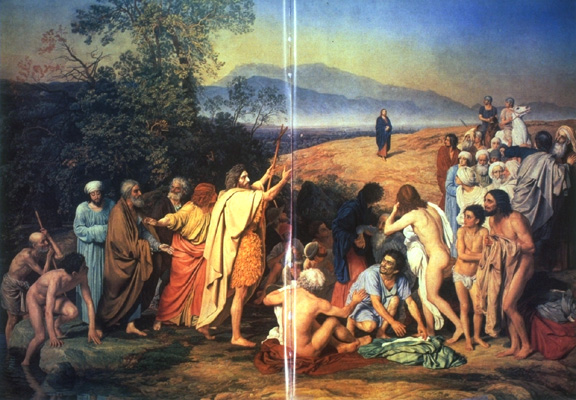
The Heavens Opened to Ezekiel
Ezekiel 1:1-3
“1 Now
it came to pass in the thirtieth year, in the fourth month, in the fifth day of
the month, as I was among the captives by the river Chebar, that the heavens
were opened, and I saw visions of God. 2In the fifth day of the
month, which was the fifth year of king Jehoiachin’s captivity, 3the
word of Jehovah came expressly unto Ezekiel the priest, the son of Buzi, in the
land of the Chaldeans by the river Chebar; and the hand of Jehovah was there
upon him.” (ASV, 1901)
In
the first verse of the Book of Ezekiel we are given the exact timing of the
visions he received. Even though there is much disagreement among commentators
regarding the specific designation of the term “thirtieth year”, the thirtieth year is most appropriately
designated as the thirtieth year of his life. He was in the resettlement area
by the river Chebar (a canal off the Euphrates River) that flowed to the east
of Babylon. Since he was taken captive along with King Jehoiachin in March of
597 B.C., this first vision would be on July 31, 593 B.C. Ezekiel saw heaven “open”.
This is similar to the experience of Jesus, where at His baptism He was thirty
years of age, and at the banks of the Jordan River when He saw heaven “open”
(Matthew 3:16; Luke 3:21)). Ezekiel cites five notable experiences, which start
the introduction to his prophetic ministry. These remained constant throughout
his prophetic career:
- · The Heavens were opened.
- · He saw visions of God.
- · The Word of the Lord came upon him. This expression means he knew God was speaking directly to him.
- · The hand of the Lord was upon him. This expression means that the Lord God was moving the prophet to do something.
- · The visions came solely to him. The Hebrew word hai means “expressly”, and is this word is used in Jeremiah and Ezekiel to describe the reception of God’s Word given uniquely to that prophet.

Other men for whom God opened the Heavens to were Daniel, Isaiah, Elisha, Stephen, Paul and John. The phrase “the hand of the Lord was upon him” or “came upon me” is found exactly seven times in the Book of Ezekiel (1:3; 3:14, 22; 8:1; 33:22; 37:1 and 40:1). This describes Ezekiel’s direction for his ministry. He was not acting on his own. These visions were from God, who chose him to minister in a very detailed manner, to the Nation Israel at a critical time in their history when they would have been quite sensitive and receptive to God’s Word. Prophetic divine revelation to a legitimate biblical prophet is an overpowering experience.
Many
commentators have difficulty with the following passages. The imagery “opened
up” to Ezekiel is impossible to describe using human terms. As a result he uses
similes and metaphors (“as” and “like”) to describe the indescribable. He sees
visions within the Throne Room of God that he cannot describe, but he must do
so anyway. He is attempting to put the magnificence of the infinite into our
finite minds. This is the task of the prophet, to convey the infinite to the
finite.
The Storm from The North
Ezekiel 1:4
“4And
I looked, and, behold, a stormy wind came out of the north, a great cloud, with
a fire infolding itself, and a brightness round about it, and out of the midst
thereof as it were glowing metal, out of the midst of the fire.” (ASV, 1901)

Photo from Sone of Sharecroppers: https://sonofsharecroppers.wordpress.com/2013/06/11/constabulary/
The
vision opens with Ezekiel looking towards and focusing his attention on “the north” where a “stormy wind, a great cloud, with a fire infolding itself is in view”.
In Jeremiah 1:14 he clearly explains that the Babylonians came from “the north” and “From the north the misfortune will break forth.” This great cloud with a stormy wind gives us
the impression that there will be an appearance of God as in other Scriptures
(Isaiah 29:6; Psalm 18:7-15, 104:3). The “fire
infolding itself” gives the imagery of judgment, which was threatening to
come upon Judah for her sins. Fire is associated with judgment in the
Scriptures (Amos 7:4; Jeremiah 15:14; Isaiah 4:4; 29:6; 66:16; Ezekiel 28:18;
30:8; Amos 1:14; Zechariah 13:9). This description of the fire lets us realize
that the fire is consuming itself without expiring. It is essentially taking
in, or engulfing itself. It is feeding or kindling itself, and adding itself as
fuel to continue the fire. It is fire, feeding fire! Picture a great wind with
clouds, bringing a fire consuming and feeding itself with the flames circle
inward, perpetually without end. This description of the consuming fire only
appears here and in Exodus 9:24 where God’s judgment is coming on Egypt in a
series of plagues. Moses relates the experience as, “So there was hail, and fire mingled with the hail, very grievous, such
as had not been in all the land of Egypt since it became a nation.”
Next
the prophet describes a metal-like substance that projects out of the middle of
the fire that has the property of glowing like a red-hot iron that has been
prepared in a blacksmith’s forge for a special task. The Hebrew text designates
the color of the fire and the metal-like object as chashmal. The Hebrew word
chashmal, is from two roots, which mean “smooth” and “brass” (Ezekiel 1:7;
Revelation 1:15). The Septuagint and Vulgate Bible translate it, “electrum”
which is described as a brilliant metal composed of gold and silver.
The Cherubim
Ezekiel 1:5-11
“5And
out of the midst thereof came the likeness of four living creatures. And this
was their appearance: they had the likeness of a man; 6and every one
had four faces, and every one of them had four wings. 7And their
feet were straight feet; and the sole of their feet was like the sole of a calf’s
foot; and they sparkled like burnished brass. 8And they had the
hands of a man under their wings on their four sides; and they four had their
faces and their wings thus: 9their wings were joined one to another;
they turned not when they went; they went every one straight forward. 10As
for the likeness of their faces, they had the face of a man; and they four had
the face of a lion on the right side; and they four had the face of an ox on
the left side; they four had also the face of an eagle. 11And their
faces and their wings were separate above; two wings of every one were joined
one to another, and two covered their bodies.” (ASV, 1901)
In
Chapter 10 these four living creatures are identified as “cherubim” in verses 5 and 20. The Hebrew word for living creature
is chayot and it is used in a number
of places in the Old Testament. They guard the Garden of Eden with flaming
swords, which closed off access to the Garden (Genesis 3:24). Cherubim were
placed on the top of the mercy seat of the Ark of the Covenant. Their likeness
was embroidered on the curtain of the Tabernacle to guard the Holy of Holies
(Exodus 25: 10-22; 26:31). The apostle John saw the same four living beings in
the Throne Room of God and around God (Revelation 4-5). The wings of the
cherubim just touch each other across the Mercy Seat in the Holy of Holies (I
Kings 6:27). The human shape supersedes the other characteristics as the
predominate form. Each Cherub has four faces and four wings, which correspond
to the human characteristics of each one. This is not a likeness of God (which
is expressly forbidden), and these are beings He created, but are not Him
(Exodus 20:4). They are obedient to His will, are His instruments used for His
highest purposes, and they carry out His commands.
Placement
wise, they are the closest celestial beings to God in His Throne Room. In these
verses they appear to be underneath the throne because Ezekiel is looking at
the vision from the vantage point of being on the earth. In Revelation 4-5
John’s vision is from the vantage point of being in Heaven and in the Throne Room
of God, and he sees the cherubim covering (or encircling) the Throne. We see a
similar scene in Ezekiel chapter 28 where he describes the fall of the anointed
cherub Halal (Latin: Lucifer), who became Satan the adversary. Before his fall,
Hallel was covering the throne of God, and was above it as the arch cherub.
So,
while the appearance of the Cherubim has the dominant characteristic of a
human, they also have feet like an ox, which are straight, or upright. There is
no foot set at a 90˚ angles from the leg. The sole of their feet in this vision
is said to be like glowing brass, as if they were burning in a furnace. This
has the implication of trampling the earth in righteous judgment.
They
all had human hands under their wings. In contrast to the legs and feet, the
hands provided them with dexterity, which the lower extremities did not have.
The hand is the symbol of “leading power, guided by skillfulness” (Psalm
78:72). These creatures were not four footed, that is like an animal with four
feet, they were like a human. Their hands are under wings, which show that they
are fitted for service in the celestial sphere. The wings are joined together
so there is perfect unity of action among the four living creatures. That is,
they moved together in perfect harmony of motion as the Lord directs. He guides
and governs their actions. In the Throne Room scene in the Revelation 4:7 and chapter
5 the four living creatures are separated, but here they are united for a
different purpose.
“They had the face of a man; and they four
had the face of a lion on the right side; and they four had the face of an ox
on the left side; they four had also the face of an eagle.” Here as
mentioned, the dominant feature is of a man, followed by a lion, then an ox and
finally an eagle. In the Revelation 4:7 the order of their likeness is the lion
first, followed by man, then the calf (ox), and finally a flying eagle. The
activity that is being carried out at God’s command is what seems to dictate
what face is described first, and in what order. In Revelation 5 the Lion of
the Tribe of Judah, our Lord Jesus, is taking control of the earth when He
takes the seven-sealed scroll, the title deed to the earth, from the hand of
God the Father (Revelation 5:5-10).
In
Ezekiel 1:10 the focus is on man, and his face is the first described,
indicating God’s tenderness of judgment. On the right Ezekiel sees the lion, on
the left the ox, and the face of the eagle is behind. The human face represents
the thought that man, who is made “after the image of God”, is the highest
symbol of the Eternal Order (Genesis 1:27).
The lion is the emblem of sovereignty, both in the Temple and in
Solomon’s palace (1 Kings 7:29; 10:20; 2 Chronicles 9:18, 19).
The
ox here is aligned with the lion, as demonstrated in the twelve oxen that
supported the “sea” or “laver” in the Temple, and clearly indicates doing work
or providing a service (1 Kings 7:25, 44). Here also we have an example of
sovereignty, where the natural symbol of strength (ox) is made subservient to
human uses.
The
eagle is the emblem of kingly power, and is used elsewhere (Ezekiel 17:3, 7).
The human face represents the Son of Man who shared in the glory of the Father.
Jesus Christ is also linked to the ox with that of His sacrifice; with the lion
with that of His sovereignty over Israel, as the Lion of the tribe of Judah
(Revelation 5:5); and with the eagle with Him bearing His people on eagles’
wings into the highest heavens (Exodus 19:4; Deuteronomy 32:11).
There is a direct
connection between the Gospels
and the Cherubim that has been recognized since the early Church Fathers
(Brown, 1997). The
Church Fathers identified them with the four Gospels like this:
·
Matthew the Lion. The
Lion expresses royalty, and calls Christ the Lion of the Tribe of Judah,
and is Christ’s prominent feature in the Book of Matthew.
·
Mark the Ox. The
Ox, expresses laboring in endurance, and is Christ’s
prominent feature
in the Book of Mark.
·
Luke the Man.
The Man, expresses brotherly sympathy with the whole race of man, and is Christ’s prominent feature in the Book of Luke.
·
John the Eagle. The Eagle, expresses soaring
majesty and also as the Divine Word, and is Christ’s prominent feature in the Book of John.

From Book of Kells
What is interesting regarding
these symbols is that they do not express
the personal character of the Evangelists, but express the different
characteristics of the Lord Jesus our Christ in relation
to the world.
This
section of Scripture closes with “and
their faces and their wings were separate above”, that is they were
stretched upward, touching the neighboring wings at the tip, and so appear
“joined,” while the other two wings covered their bodies and were never
stretched out or up. The effect was to form a “box-like” pattern with a Cherub
at each corner. Because they were ministering in God’s presence, they covered
their bodies in holy reverence toward God the Father who is seated on the
Throne. The
Mercy Seat over the Ark of the Covenant was made of gold after a pattern of the
“chariot” of the Cherubim (which is described in detail in the upcoming
verses). Their wings spread out over the Ark of the Covenant of the Lord. This
description was conveyed to David from God:
I Chronicles 28:18-19
“18and
for the altar of incense refined gold by weight; and gold for the pattern of
the chariot, even the cherubim, that spread out their wings, and covered the
ark of the covenant of Jehovah. 19All this, said David, have I been
made to understand in writing from the hand of Jehovah, even all the works of
this pattern.” (ASV, 1901)
The Chariot
Ezekiel 1:15
“15Now
as I beheld the living creatures, behold, one wheel upon the earth beside the
living creatures, for each of the four faces thereof.” (ASV 1901)

Wheels within Wheels by Larsen
Ezekiel
next sees “the living creatures”
(Cherubim) as having mobility with a set of wheels (in Hebrew the word is opan). Even though this vision was of a
Heavenly scene, the wheels of the Cherubim extend to the earth indicating God’s
sovereignty over the earth. He saw four wheels, one for each of the four faces on
each Cherubim. The wheels are said to be “beside”
the Cherubim. The wheels Ezekiel saw were the lowest part of the chariot-throne,
and sat on the ground below the Cherubim. We get the image of the Cherubim
being attached to the wheels, as if they themselves are the wagon or platform
of the wheels. This completes the vehicle on which God will be transported, or
supported, from one location to another.
The
prophet Daniel was allowed to see a vision of a similar nature. He saw the
glory of God on His Throne and the wheels of the Cherubim’s chariot of fire:
Daniel 7:9-10
“9I
beheld till thrones were placed, and one that was ancient of days did sit: his
raiment was white as snow, and the hair of his head like pure wool; his throne
was fiery flames, and the wheels thereof burning fire. 10A fiery
stream issued and came forth from before him: thousands of thousands ministered
unto him, and ten thousand times ten thousand stood before him: the judgment
was set, and the books were opened.” (ASV, 1901)
The Wheels
Ezekiel 1:16
“16The
appearance of the wheels and their work was like unto a beryl: and they four
had one likeness; and their appearance and their work was as it were a wheel
within a wheel.” (ASV, 1901)
Ezekiel
begins to describe the wheels of the chariot and starts by describing them as
the color of “beryl”, which was
probably a green, or turquoise. The Hebrew word for “beryl” is tarsheesh, and
suggests the name of the region where the stone is mined, which is Tarshish.
This is a divine color and is found on the fourth row of the breastplate of the
high priest (Exodus 28:20).
Each
of the four wheels had another wheel within itself, placed at a right angle. It
had the appearance of a gyroscope. A gyroscope is a device with a spinning
wheel, consisting of another wheel within it, that spins rapidly like a child’s
top. The spinning motion keeps the stability evenly fixed regardless of the
direction in which it moves. The
gyroscope is an accurate navigational instrument and an effective stabilizing
device in ships and airplanes. Having a wheel inside a wheel allows the chariot
to immediately change direction. It is as if the wheel inside a wheel produces
a freedom of movement unique to Heaven, apart from the constraints of the physics
of time and space in the universe. They can be said to “hover” as opposed to
simply move. This high level of mobility symbolizes the omnipresence of God.
This is a crude comparison, but it is helpful to try and describe God’s great
motion as the Cherubim in the chariot move Him as He commands.
Ezekiel 1:17-18
“17When
they went, they went in their four directions: they turned not when they went. 18As
for their rims, they were high and dreadful; and they four had their rims full
of eyes round about.” (ASV, 1901)
The
wheels sparkled with the color. The sparkling wheels appeared to Ezekiel like the
appearance of precious stones, which could roll in four directions without
turning themselves. Ezekiel describes the wheels as rims, and says they were “high and dreadful” (in Hebrew the word
is yerah). His description is one of
witnessing wheels that were large, an astounding, or awesome sight, but not one
that is frightening. His vision is further compounded by the appearance of “eyes” all around the rims of the wheels.
These are symbolic of God’s divine omniscience in the creation at all levels,
and all times (II Chronicles 16:9; Proverbs 16:3; Zechariah 3:9, 4:10;
Revelation 4:6). They represent God’s complete, perfect divine intellect.
Simply put, God knows everything, including our thoughts.
Ezekiel 1:19-21
“19And
when the living creatures went, the wheels went beside them; and when the
living creatures were lifted up from the earth, the wheels were lifted up. 20Whithersoever
the spirit was to go, they went; thither was the spirit to go: and the wheels
were lifted up beside them; for the spirit of the living creature was in the
wheels. 21When those went, these went; and when those stood, these
stood; and when those were lifted up from the earth, the wheels were lifted up
beside them: for the spirit of the living creature was in the wheels.” (ASV,
1901)
The
Cherubim clearly moved in concert with the chariot and its wheels, and also in
whatever direction it moved. Since they were seen from the vantage point of
being on the earth as well as in Heaven, their direction of movement appeared
to be lifted up from the earth toward Heaven. The directions for the movement come
from the Spirit of God Himself. The Hebrew word ruach (which means “wind”) is used by Ezekiel to describe the
Spirit of God. So, the movement of the Cherubim and their chariot was given
over entirely to the Spirit of God who directed them. In verse 20 Ezekiel
describes the four Cherubim as one by specifying them as singular; he says “the spirit of the living creature was
in the wheels” (underlining added). In some way the Spirit of God was
directing the motion of the Cherubim through the wheels of the chariot, but all
three were interconnected, or bound up together, as they moved from position to
position. In this instance the activity Ezekiel sees is a single unit of God’s
Spirit, the Cherubim and the wheels of the chariot moving in concert up from
the earth. This interconnectedness is important for us to grasp since it is
repeated in verse 21. The only difference between the two verses is that verse
20 describes the Spirit’s designation of direction, and verse 22 is affirming
this with the added statement, “When those
went, these went; and when those stood, these stood.”
The Firmament
Ezekiel 1:22-24
“22And
over the head of the living creature there was the likeness of a firmament,
like the terrible crystal to look upon, stretched forth over their heads above.
23And under the firmament were their wings straight, the one toward
the other: every one had two, which covered on this side, and every one had
two, which covered on that side, their bodies 24And when they went,
I heard the noise of their wings like the noise of great waters, like the voice
of the Almighty, a noise of tumult like the noise of a host: when they stood,
they let down their wings 25And there was a voice above the
firmament that was over their heads: when they stood, they let down their wings.”
(ASV, 1901)

The Cherubim had their wings outstretched so that they rose above their heads. This image lets us see the adoration the Cherubim have for the Almighty God. Their wings extended into the “firmament” or space (in Hebrew the word is rakeeah), which had the appearance of “terrible crystal”, or gleamingly awesome. This Hebrew word rakeeah means, “to spread out” or “stretch”. Some other places in Scripture where this same expression is used are:
·
He alone stretches out the heavens. (Job 9:8)
·
The heavens are stretched out like a tent
curtain. (Psalm 104:2)
·
God stretches out the heavens like a curtain and
spreads them out like a tent to dwell in. (Isaiah 40: 22)
·
The Lord has stretched out the heavens. (Jeremiah
10: 12)
·
God stretched out the heavens. (Zechariah 12:1)
These
usages of rakeeah are not quaint
poetic hyperbole or exaggerations. They are meant to express the properties of
the heavens that we cannot see, or fully understand. Space is not an empty
vacuum. We have difficulty defining space and understanding this concept of the
property of space. Scripture gives us some insight as to some of its
properties.
·
Space can be torn. (Isaiah 64: 1)
·
It can be worn out like a garment. (Psalm 102:
25)
·
It can be shaken. (Hebrews 12:26; Haggai 2:6; Isaiah
13:13).
·
It can be burnt up. (II Peter 3:12)
·
It can be split apart like a scroll. (Revelation
6:14)
·
It can be rolled up like a mantle, or scroll.
(Isaiah 34: 4, Hebrews 1:12)
The
shining brilliance of the expanse above the Cherubim that Ezekiel saw reminded
him of crystals sparkling in the light of the sun. When the Apostle John was
spiritized on the Isle of Patmos, he saw the Throne Room of God, and he said
the expanse around God’s throne is clear as “crystal” (Revelation 4:6). As the Cherubim moved their wings they
created a sound that Ezekiel likened to a great waterfall, with its deafening
sound so loud that it
overpowered any other sounds. As the creature moved, Ezekiel also hears a
second sound, “like the voice of the
Almighty,” which resembles thunder, or the movement of ancient armed forces
(“a host”). These sounds only
occurred as the Cherubim were in motion. Clearly their wings enabled them to
propel themselves as the motion stopped when their wings stopped moving.
The Throne of God
Ezekiel 1:26
“26And
above the firmament that was over their heads was the likeness of a throne, as
the appearance of a sapphire stone; and upon the likeness of the throne was a
likeness as the appearance of a man upon it above.” (ASV, 1901)
As
the Cherubim came to a stop Ezekiel noticed another sound. It was a voice that
came from the firmament over the heads and upstretched wings of the Cherubim.
This is the voice of God on His Throne in Heaven, but connected to the earth in
divine sovereignty. He had the appearance of a man. Daniel also saw and
commented on God as having the appearance of a man (Daniel 7:9). Since humans
were made in the image of God, this appears to be the form of God, that is, He
has a semblance of a human being, which is His created creature (Genesis 1:26).
In the chapters 4 and 5 of the book of Revelation, He has a dual appearance as
God on the Throne, and the Lamb. The Lamb is the Lord Jesus, and is distinct
from God the Father. In this vision it appears that the two characteristics of the
Spirit and human form are combined. The preincarnate visions of the Lord given
to Ezekiel and Daniel allowed them to see the human-like characteristic of God.
(It is interesting to note that those details were only given to them, and
other prophets, but was not given to Moses.)
The
Throne itself is the color blue, which appears to resemble a sapphire, or the lapis
lazuli stone. This vision is similar to that which was witnessed by Moses and
the seventy elders:
Exodus 24:10
“10and
they saw the God of Israel; and there was under his feet as it were a paved
work of sapphire stone, and as it were the very heaven for clearness.” (ASV,
1901)
God on His Throne
Ezekiel 1:27
“27And
I saw as it were glowing metal, as the appearance of fire within it round
about, from the appearance of his loins and upward; and from the appearance of
his loins and downward I saw as it were the appearance of fire, and there was
brightness round about him.” (ASV, 1901)
Focusing
his entire attention on the Lord of all creation, Ezekiel again describes the color
of the fire and the metal-like object in what the Hebrew text calls chashmal. The chashmal seems to be divided at the waist of God on His Throne. The
fire seems to begin at the waist, and extend upward and downward in both
directions simultaneously. The brightness he saw extended all around Him. All
Ezekiel could do was to describe the burning brilliance and magnificence of the
color. Daniel, also, had a similar
vision and experience:
Daniel 10:5-6
“5I
lifted up mine eyes, and looked, and, behold, a man clothed in linen, whose
loins were girded with pure gold of Uphaz: 6his body also was like
the beryl, and his face as the appearance of lightning, and his eyes as flaming
torches, and his arms and his feet like unto burnished brass, and the voice of
his words like the voice of a multitude.” (ASV, 1901)
The
Apostle John had a similar vision of the risen Lord in His glorified state:
Revelation 1:13-15
“13 and
in the midst of the seven candlesticks one like unto the Son of man, clothed
with a garment down to the foot, and girt about the paps with a golden girdle. 14 His
head and his hairs were white like wool, as white as snow; and his eyes were as
a flame of fire; 15 and his feet like unto fine brass, as if
they burned in a furnace; and his voice as the sound of many waters.” (KJV)
The
similarity of these visions lets us know that God has a general human-like
appearance.
Ezekiel 1:28
“28As
the appearance of the bow that is in the cloud in the day of rain, so was the
appearance of the brightness round about. This was the appearance of the
likeness of the glory of Jehovah. And when I saw it, I fell upon my face, and I
heard a voice of one that spake.” (ASV, 1901)
Surrounding
the Throne was a brilliance that appeared to be a rainbow. Within the
brilliance of the fire, and brightness of the glory of the Lord, Ezekiel again
describes the shape, or form, of a man in its midst. Ezekiel was overcome with
what he saw, and immediately sensed the need to prostrate himself in worship in
front of Him. This fantastic opening vision of Ezekiel’s ministry affirms three
significant truths about God that are summarized here:
· The vision reaffirms the nature of God as holy,
powerful, and majestic.
·
The
rainbow is a reminder that God makes and keeps His promises, and that God can
and will help humanity. (Genesis 9:13, 16).
·
It is an
assurance that nothing, including geographic location, can ever separate a
believer from God (Romans 8:38–39).
Reference
Brown, David. (1887,
1997). A Commentary, Critical and Explanatory, on the Old and New Testaments Oak Harbor,
WA: Logos Research Systems,
Inc.
Encyclopedia Judaica. (1999). CD ROM Vol. 6.
Wenger, Paul D. (1999). The
Journey from Texts to Translation, the Origin and Development of the Bible.
Grand Rapids, MI: Bridge Point Books Division of Baker Books.
Rosenberg, Rabbi A.J. (1991). The Book of Ezekiel. NY: The Judaica
Press, Inc.