The Seventy-Five Day Interval
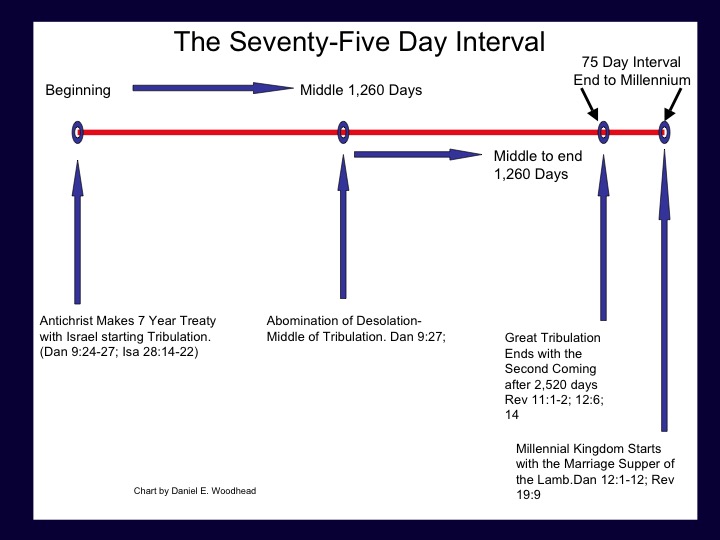
The Millennium (also called the Theocratic Kingdom, or the Messianic Kingdom) does not start right away at the close of the Great Tribulation. Scripture tells us that the duration of the first half of the Great Tribulation is 1,260 days (3 ½ years). This is the length of the time between two significant events. They are the signing of the covenant with Israel by the Antichrist, initiating the Great Tribulation, and the Abomination of Desolation being set up in the Temple, which is the mid point event. Scripture also tells us that the last half of the Tribulation will be 1,260 days counting from the Abomination of Desolation to the demise of the Antichrist. These two sets of 3 ½ years each equal a total of seven years. When comparing several Scripture passages, that reference the Great Tribulation’s duration, another specific time interval is noted. This is a seventy-five day interval at the end of the Great Tribulation and prior to the establishment of the Messianic Kingdom. The interval is described in Daniel, and the differences in numbers are intentional, they are not scribal error:
Daniel 12:11-12
“11And from the time that the continual burnt-offering shall be taken away, and the abomination that maketh desolate set up, there shall be a thousand and two hundred and ninety days [1290]. 12Blessed is he that waiteth, and cometh to the thousand three hundred and five and thirty days [1335].” (KJV, brackets added)
The Daniel passage gives us two additional figures. The first is 1,290 days, or an additional thirty days, during which time the Abomination of Desolation will remain in the Temple before it is removed. The second figure is 1,335 days, which is another 45 days beyond the 1,290 and 75 days beyond the 1,260 days. A special blessing is pronounced upon those who survive to the 1,335th day. The blessing is, for those who survive, to be able to enter into the Messianic Kingdom. Many will not make it that far, even though they made it to the end of the Tribulation. The events and the time intervals are illustrated on the following chart:
- 75 Day Interval Chart by Daniel Woodhead
There are nine events that occur during this 75-day period are:
- The removal of the Abomination of Desolation from the Temple.
- The final destination of the Antichrist.
- The final destination of the False Prophet.
- The binding of Satan.
- The judgment of the Gentiles.
- The resurrection of the Old Testament Saints.
- The resurrection of the Tribulation Saints.
- The Marriage Feast of the Lamb (this is the formal start of the Millennium)
1. The Removal of the Abomination of Desolation
The pivotal event, which signals the mid-point of the Great Tribulation, is the Antichrist’s takeover of the Jewish Temple. He breaks his covenant with the Jews, and declares himself “The Almighty God” (II Thessalonians 2:4). He also begins a serious persecution of the Jews, which will last for 1,260 days. The False Prophet sets up an inanimate image of the Antichrist in the Temple and Satan, through the False Prophet, causes it to become alive. The Antichrist is in control of the world for those 1,260 days and then he will be killed. The image stays in the Temple for additional thirty days.
Daniel 12:11
“11And from the time that the continual burnt-offering shall be taken away, and the abomination that maketh desolate set up, there shall be a thousand and two hundred and ninety days.” (KJV)
The desecration of the Jewish Temple continues an additional thirty days beyond the end of the Great Tribulation. It will then be destroyed, which brings the Abomination of Desolation to an end. It is not clear why God allows the Abomination of Desolation to remain in the Temple for 30 days after the Great Tribulation ends.
2. The Judgment of the Gentiles
The Olivet Discourse of Jesus to His inner circle of Peter, James, John, and Andrew comes to an end with the Judgment of the Gentiles. Even though a significant number of Gentiles will be killed during the Great Tribulation (and their armies will be slaughtered in the Campaign of Armageddon) some will make it through alive. They will be gathered together for the purpose of a special judgment.
There are two passages of Scripture that give the insight into the Judgment of the Gentiles:
Matthew 25:31-46
“31When the Son of man shall come in his glory, and all the holy angels with him, then shall he sit upon the throne of his glory: 32And before him shall be gathered all nations:33and he shall separate them one from another, as a shepherd divideth [his] sheep from the goats: And he shall set the sheep on his right hand, but the goats on the left. 34Then shall the King say unto them on his right hand, Come, ye blessed of my Father, inherit the kingdom prepared for you from the foundation of the world: 35For I was an hungred, and ye gave me meat: I was thirsty, and ye gave me drink: I was a stranger, and ye took me in: 36Naked, and ye clothed me: I was sick, and ye visited me: I was in prison, and ye came unto me. 37Then shall the righteous answer him, saying, Lord, when saw we thee an hungred, and fed [thee]? or thirsty, and gave [thee] drink? 38When saw we thee a stranger, and took [thee] in? or naked, and clothed [thee]? 39Or when saw we thee sick, or in prison, and came unto thee? 40And the King shall answer and say unto them, Verily I say unto you, Inasmuch as ye have done [it] unto one of the least of these my brethren, ye have done [it] unto me. 41Then shall he say also unto them on the left hand, Depart from me, ye cursed, into everlasting fire, prepared for the devil and his angels: 42For I was an hungred, and ye gave me no meat: I was thirsty, and ye gave me no drink: 43I was a stranger, and ye took me not in: naked, and ye clothed me not: sick, and in prison, and ye visited me not. 44Then shall they also answer him, saying, Lord, when saw we thee an hungred, or athirst, or a stranger, or naked, or sick, or in prison, and did not minister unto thee? 45Then shall he answer them, saying, Verily I say unto you, Inasmuch as ye did [it] not to one of the least of these, ye did [it] not to me. 46And these shall go away into everlasting punishment: but the righteous into life eternal.” (KJV)
This passage confirms the timing of the judgment, which will be after the Second Coming of the Messiah, when the Throne of David will be set up as described in verse 31 above.
The place of the judgment is not given in this passage, but the prophet Joel does discuss it:
Joel 3:1-3
“1For, behold, in those days, and in that time, when I shall bring back the captivity of Judah and Jerusalem, 2I will gather all nations, and will bring them down into the valley of Jehoshaphat; and I will execute judgment upon them there for my people and for my heritage Israel, whom they have scattered among the nations: 3and they have parted my land, and have cast lots for my people, and have given a boy for a harlot, and sold a girl for wine, that they may drink.” (KJV, underlining added)
This judgment that will take place just outside the City of Jerusalem, in the Valley of Jehoshaphat, which lies between the city and the Mount of Olives.
- Ancient City of Jerusalem and Valley of Jehosaphat.
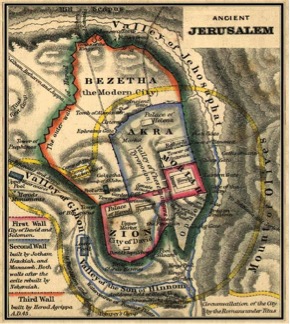
Source: http://commons.wikimedia.org/wiki/File:Ancient_Jerusalem_Modern_Jerusalem.jpg
Joel also confirms that this judgment is to occur near the time of the restoration of the Nation Israel, which is at the end of the Great Tribulation. All the Gentiles surviving after the war will be gathered into the Valley of Jehoshaphat for the judgment. This is the same place on the east of the Temple Mount next to the Mount of Olives where the final battle took place. The term “Gentiles” is the same as “all nations”. This judgment will be for the purpose of determining their individual final destination of eternal life or eternal hell. Therefore, it is a very serious event. The basis for the judgment will be how they treated the Jews during the Tribulation. The sins cited by Joel include: scattering the Jews in the middle of the Great Tribulation, parting the land during the Campaign of Armageddon, and selling the Jews into slavery (Zechariah 14:1-2).
Each Gentile will be judged on the basis his or her participation in, or refusal to participate in, these actions. The Lord Jesus gave us the results of the judgment during the Olivet Discourse (Matthew 25:31-46). He identifies the judge, the judgment, and those who are judged in Matthew’s gospel:
Matthew 25:31-33
“31When the Son of man shall come in his glory, and all the holy angels with him, then shall he sit upon the throne of his glory: 32And before him shall be gathered all nations: 33and he shall separate them one from another, as a shepherd divideth [his] sheep from the goats: And he shall set the sheep on his right hand, but the goats on the left.” (KJV)
The Judge
Jesus (“Son of man”) is the judge who will sit on a throne in the all His glory in the Valley of Jehoshaphat.
The Judged
The subjects of the judgment are individuals, and not a judgment of nations (verses 32-33). The Greek word for “nations” is ethnos, which is Strong’s #1484, and it means “all those who are not Jews”. In other words it means the Gentiles. The word “nations” is the common term for Gentiles used in the Bible. All the Gentiles who survive the Tribulation, and the Campaign of Armageddon, will be gathered into the Valley of Jehoshaphat, and will then be separated by the Messiah. There are three specific groups mentioned in this passage: the “sheep” Gentiles, the “goat” Gentiles, and the “brethren”. Some Gentiles are brought to His right-hand side and are called “sheep”, and those Gentiles brought to His left-hand side are called “goats”. Note the positional aspect of the decision, being put to the right or left side of Jesus the Judge. The pro-Jewish Gentiles are known as the “sheep” camp and the anti-Jewish Gentiles are known as the “goat” camp. Matthew also discusses the pro-Jewish sheep camp:
Matthew 25:34-40
“34Then shall the King say unto them on his right hand, Come, ye blessed of my Father, inherit the kingdom prepared for you from the foundation of the world: 35For I was an hungred, and ye gave me meat: I was thirsty, and ye gave me drink: I was a stranger, and ye took me in: 36Naked, and ye clothed me: I was sick, and ye visited me: I was in prison, and ye came unto me. 37Then shall the righteous answer him, saying, Lord, when saw we thee an hungred, and fed [thee]? or thirsty, and gave [thee] drink? 38When saw we thee a stranger, and took [thee] in? or naked, and clothed [thee]? 39Or when saw we thee sick, or in prison, and came unto thee? 40And the King shall answer and say unto them, Verily I say unto you, Inasmuch as ye have done [it] unto one of the least of these my brethren, ye have done [it] unto me.” (KJV)
“The Sheep” - Gentiles Helping The Jews
Jesus describes those who helped His “brethren”, the Jews, during the Great Tribulation as “sheep”. Remember, the church had not yet been formed when Christ’s Olivet Discourse was given. Therefore, His usage of the term “brethren” in this context refers to the Jews. These Gentiles will be putting themselves in mortal danger, just as it was during World War II when the Nazis were hunting the Jews and killing those non-Jews who hid or aided them. The Jews will flee into the wilderness without provisions. The pro-Jewish “sheep” will provide them with food, clothing and shelter. They will visit them in prison, and in general show kindness toward them. The result of their judgment is being given permission to enter into the Messianic Kingdom. It is the “sheep” Gentiles who will be involved in the destruction of Babylon (Isaiah 13:1-5). They will be the “resistance fighters” who are instrumental in overthrowing the one-world government that will be headquartered at Babylon.
Some have tried to interpret the term “brethren” as referring to saints in general, but this makes the passage meaningless. If the “brethren” are saints in general, then who are the “sheep” since they too have eternal life? It would be very confusing to make both the “sheep” and the “brethren” as saints of the same order. From this context alone, it should be very evident that the “brethren” must refer to Jewish people because the saints are the “sheep” and the unsaved are the “goats”. Furthermore, the parallel passage of Joel 3:1-3 makes it certain that these “brethren” are the Jewish people of the Great Tribulation. The term “brethren” here is used in the sense of “brethren in the flesh.” The fact that only Matthew records this segment of the Olivet Discourse also teaches the same truth. Matthew’s gospel was directed at a Jewish audience, and since his is the most “Jewish” of the Gospels, his primary concern has been how the Messiah’s coming will affect the Jewish people.
The “sheep”, which are pro-Jewish, are clearly stated to be the “righteous” ones. Will they be saved because they are pro-Jewish? This cannot be true because that would make their salvation be based on their works, and not the work of God. This passage is an example of James 2:14-26, that distinguishes between perfecting one’s faith through our works, as compared to one who is basing their salvation only on faith without any works. Because these Gentiles are already believers in the Lord Jesus Christ, they will refuse to do the commands of the Antichrist to destroy the Jews. So, while Jews will undergo a great persecution, these believing Gentiles will do what they can to help the Jews under these conditions. A believer will follow Christ’s commandments, and will not follow the Antichrist. Their works toward the Messiah’s “brethren” will prove their faith. They will be allowed to enter into the Messianic Kingdom because they are saved Gentiles, and they will be the ones to populate the Gentile nations during the Messianic Kingdom (vv.34-40).
The “Goats” - Gentiles Who Harmed The Jews
On the other hand, the “goats” will be the anti-Jewish Gentiles who, because of their unbelief in Jesus, will join the ranks of the persecutors under the Antichrist’s authority. They will show their lack of faith by their works. They are the ones who will not be “watching”, “ready” or “laboring”, in violation of the five parables. For this reason they will be left out of the Messianic Kingdom:
Matthew 25:41-45
41Then shall he say also unto them on the left hand, Depart from me, ye cursed, into everlasting fire, prepared for the devil and his angels: 42For I was an hungred, and ye gave me no meat: I was thirsty, and ye gave me no drink: 43I was a stranger, and ye took me not in: naked, and ye clothed me not: sick, and in prison, and ye visited me not. 44Then shall they also answer him, saying, Lord, when saw we thee an hungred, or athirst, or a stranger, or naked, or sick, or in prison, and did not minister unto thee? 45Then shall he answer them, saying, Verily I say unto you, Inasmuch as ye did [it] not to one of the least of these, ye did [it] not to me.” (KJV)
They will be killed and sent directly to Hell. This judgment is not judging them on works, but whether or not they believed in the Messiah, and sends those who harmed the Jews to Hell.
3. The Antichrist’s Final destination
Revelation 19:20 makes is quite clear the Antichrist will meet his final demise:
Revelation 19:20
“20And the beast was taken, and with him the false prophet that wrought miracles before him, with which he deceived them that had received the mark of the beast, and them that worshipped his image. These both were cast alive into a lake of fire burning with brimstone.” (KJV)
The text states that the Antichrist will be “cast alive” into the Lake of Fire. The Antichrist is killed at the end of the Great Tribulation and while his body will not be buried, his soul will be in Hell (Habakkuk 3:13b; II Thessalonians 2:8; Isaiah14:3-11; 16-21). As armed forces of the Antichrist flee Christ’s slaughter, his body will be trampled under their feet (Isaiah 14:19-21). So if the text states that he will be “cast alive into a lake of fire”, he must come back to life in order for that to occur. There is the Second Resurrection and it only applies to the resurrection of the damned (those who did not accept Christ when they had the opportunity), which like the First Resurrection also comes in stages. Jesus, the second person of the Holy Trinity, is the “first fruits” of the First Resurrection. Interestingly, the Antichrist will be the “first fruits” of the Second Resurrection. The result of his resurrection will end with his eternal destiny in the Lake of Fire.
3a. The Lake of Fire
The “lake of fire burning with brimstone” is that which Christ referred as Gehenna, and is also called the Lake of Fire (Matthew 5:22, 29-30, 10:28, 18:9, 23:15, 33; Mark 9:43, 45, 47; Luke 12:5). The Greek work for the Lake of Fire is Gehenna, and is named for the Valley of Hinnom just south of Jerusalem. It was at this site that the Jews offered their children to god Molech (II Kings 23:10; Jeremiah 7:31; 19:2-6). In later times it served as a continually burning garbage dump, and therefore provided the imagery that the Bible uses to describe the place of everlasting punishment. The Lake of Fire is where all those who do not believe in Christ will reside forever. The Lake of Fire is where the contents of Hell will be deposited. Hell is a place of a spiritual punishment. The Lake of Fire will be a place of punishment for the resurrected bodies of the unbelievers and their spirits. Being thrown into the Lake of Fire is the Second Death, and is the final destination of the wicked.
3b. The False Prophet
According to Revelation 19:20 the False Prophet will have a counterfeit gift of performing miracles for the sole purpose of deceiving the world so that they worship the Antichrist (beast) and take his mark of 666.
Revelation 19:20
“20And the beast was taken, and with him the false prophet that wrought miracles before him, with which he deceived them that had received the mark of the beast, and them that worshipped his image. These both were cast alive into a lake of fire burning with brimstone.” (KJV)
He will be “cast alive” into the Lake of Fire along with the Antichrist. These two members of the “unholy trinity” (the Antichrist masquerading as the counterfeit “son”, and the false prophet masquerading as the counterfeit “holy spirit”) will the only occupants for the first 1,000 years that the Lake of Fire will be operational. What a appropriate destiny for the two men who instituted Hell on earth for seven years!
4a. Satan’s Binding
Satan, who masquerades as the counterfeit father in the “unholy trinity”, will be cast into the abyss.
Revelation 20:1-3
“1And I saw an angel come down from heaven, having the key of the bottomless pit and a great chain in his hand. 2And he laid hold on the dragon, that old serpent, which is the Devil, and Satan, and bound him a thousand years, 3And cast him into the bottomless pit, and shut him up, and set a seal upon him, that he should deceive the nations no more, till the thousand years should be fulfilled: and after that he must be loosed a little season.” (KJV)
Here we see the binding of Satan, who was cherub and of the highest order of celestial beings in Heaven. The one who does the binding is a common angel, who is the lowest order of celestial beings in Heaven. How fitting for Satan who was the highest of the highest rank of celestial beings to be bound by one from the lowest rank! Satan will be bound for 1,000 years, which is the duration of the Millennial Kingdom on earth. He will no longer be free to be the great deceiver of mankind. He will reside in the Abyss. The binding is done with the promise that Satan will be released for a short time to again test mankind at least one more time.
4b. The Abyss
The New Testament tells us that this is the temporary dwelling place of the imprisoned demons (Revelation 9:1-21). In classical Greek it is the adjective abussos. It refers to an “unfathomable or boundlessly deep place”. Many of the demons that Jesus expelled from the earth were committed to the abyss. They dreaded going there before their appointed time (Luke 8:31). Millions of them will be let loosed during the Great Tribulation in two separate invasions to wreck havoc on the earth. At this time they begin to appear so the human population can see them. Up until this time, when the fifth and sixth trumpets are sounded, the demonic world is unseen to the human eye (Revelation 9).
5. The First Resurrection
The first resurrection involves only believers and it is found in Revelation 20:
“Revelation 20:5-6
5But the rest of the dead lived not again until the thousand years were finished. This is the first resurrection. 6Blessed and holy is he that hath part in the first resurrection: on such the second death hath no power, but they shall be priests of God and of Christ, and shall reign with him a thousand years.” (KJV)
According to verse five, the resurrection of the Great Tribulation saints completes the First Resurrection. It is separated from the Second Resurrection by one thousand years. The whole point of verse six states that the First Resurrection involves only believers, and that is why it is a “blessed” event for those who participate in it.
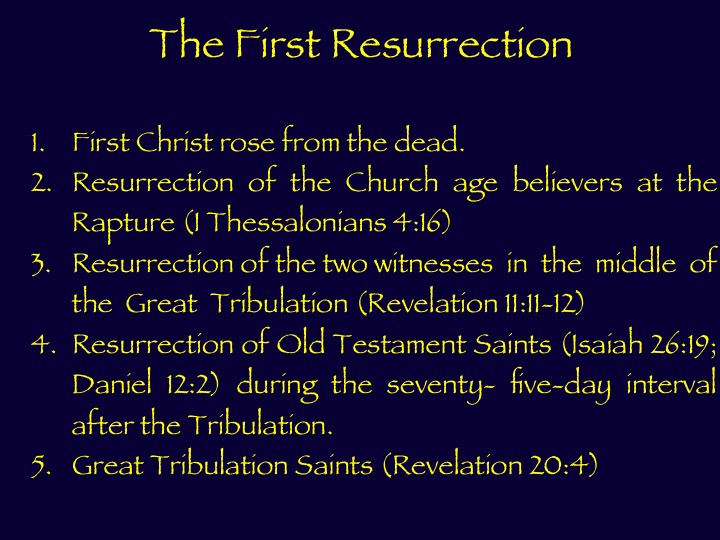
It is important for us to realize that the First Resurrection is not a general resurrection of all the dead at one time. The Bible teaches in 1 Corinthians 15: 20-23 that it is an orderly sequence and occurs in the five stages:
1 Corinthians 15:20-23
“20But now is Christ risen from the dead, and become the first fruits of them that slept. 21For since by man came death, by man came also the resurrection of the dead. 22For as in Adam all die, even so in Christ shall all be made alive. 23But every man in his own order: Christ the first fruits; afterward they that are Christ's at his coming.” (KJV)
This shows that all of the Christians shall live again, or be resurrected, and that there is an orderly progression to the stages of this resurrection. After declaring that a resurrection of the righteous will occur in verse 23, Paul states that the righteous will be resurrected each “in his own order”. The word “order” is a military term used to describe the orderly procession of troops marching to battle (in Greek it is tagma). It always refers to an orderly procession such as the movement of troops, or an orderly procession of the priests in the Old Testament. The central point of this passage is that there is an orderly, and sequential process, to the first resurrection, and includes these five stages:
- The First Resurrection Stages
6. The Resurrection of Old Testament Saints
We must keep in mind that the Rapture only includes the Church, that is, those who have accepted Jesus of Nazareth and confessed His name before other men on this earth:
Romans 10:9
“9That if thou shalt confess with thy mouth the Lord Jesus, and shalt believe in thine heart that God hath raised him from the dead, thou shalt be saved.” (KJV)
This verse, along with many others, further refines and gives explicit instruction in how to actualize our faith. We must tell others what has taken place in our hearts. It is similar to being obedient, and carrying out the commandment to be baptized. Both are outward signs attesting to the transformation that the Lord has brought about within us. So those, who have done this prior to the Great Tribulation, will have already gone up to Heaven to meet the Lord in the air at the time of the Rapture (I Thessalonians 4:16-17).
The following two passages speak about believers from the Old Testament times who loved God, and who were waiting for His coming in the flesh. However, they died prior to Christ appearing on the planet. This is not to say they kept the Law, it means that they believed God and took Him at His Word. The Old Testament saints were the righteous ones waiting for the Lord’s appearing, like Simeon was in Luke 2:25. They will be rewarded for their belief:
Isaiah 26:19
“19Thy dead shall live; my dead bodies shall arise. Awake and sing, ye that dwell in the dust; for thy dew is as the dew of herbs, and the earth shall cast forth the dead.” (KJV)
This passage states that the Old Testament saints were guaranteed a resurrection, but it does not say when. Other verses bring the concept into clearer focus for us:
Daniel 12:2
“2And many of them that sleep in the dust of the earth shall awake, some to shame [and] everlasting contempt.” (KJV)
This passage draws a very clear distinction between the righteous and the unrighteous. Within the context of the twelfth chapter of Daniel, this verse is speaking of a particular time at the “end.” It is addressed to the Jews who are identified as “your people” (Daniel 12:1). Only the righteous will be resurrected at this time to partake in the blessing of the Millennial Kingdom. These are also known as “the friends of the bridegroom” spoken of by John the Baptist (John 3:29). Since the context of Daniel chapter twelve is speaking of the events after the Great Tribulation, it is at that time that the Old Testament saints will be resurrected.
7. The Resurrection of Tribulation Saints
There will also be a resurrection of those saints who became believers and were killed during the Great Tribulation. Revelation 20:4 tells us the facts surrounding this event:
Revelation 20:4
“4And I saw thrones, and they sat upon them, and judgment was given unto them: and [I saw] the souls of them that were beheaded for the witness of Jesus, and for the word of God, and which had not worshipped the beast, neither his image, neither had received [his] mark upon their foreheads, or in their hands; and they lived and reigned with Christ a thousand years.” (KJV)
Here the apostle John sees two groups of people co-reigning with the Lord Jesus. The first group is those who already had received their judgment for their works from Christ. The judgment, called the Bema Seat Judgment, is referenced in Romans 14:10 and 2 Corinthians 5:10. This will be the Church age saints who are resurrected at the Rapture of the Church. They receive the judgment of their works, and their rewards, right after they enter Heaven from Christ (1 Corinthians 3).
The second group is identified as those souls who have been beheaded for the testimony of Jesus. They were beheaded because they would not worship the Antichrist, nor would they consent to receive the mark of the Beast (666). These are the Tribulation saints. They go into the Millennial Kingdom with Christ.
8. The Marriage Feast of the Lamb
In the ancient Jewish wedding, the wedding feast was the last of four stages. The four stages of the ancient Jewish wedding are reflected in the events planned long ago by God the Father:
- The Father of the Groom made the arrangement for the Bride and paid the bride price. In this case the price was the blood of Jesus (Ephesians 5:25-29).
- The fetching of the Bride is when she is ready and waiting to be escorted by her Bridegroom to the home of his father. This is comparable to the Rapture of the Church (I Thessalonians 4:13-18).
- The marriage ceremony of the Bride to the Groom, or when the Church weds the Messiah happens immediately after arriving at his father’s house (Church age saints are now in Heaven with Christ) (Revelation 19:6-8).
- The wedding, or marriage feast, is the last event of the sequence and lasts for seven days. The Marriage Feast of the Lamb is the event that begins the Messianic Kingdom.
The Church is the bride and is married to Christ in Heaven after the Rapture. The First Resurrection brings the Old Testament saints, who are the friends of the bridegroom, and the Great Tribulation saints, who are also invitees, to complete the invited “guest list” to the wedding, and now the wedding feast can take place. The invitation has already been issued:
Revelation 19:9
“9And he saith unto me, Write, Blessed are they which are called unto the marriage supper of the Lamb. And he saith unto me, These are the true sayings of God.” (KJV)
The result of this invitation is the First Resurrection to be followed by the wedding feast, which will last for seven days. Christ spoke of this during the Last Supper as He raised His glass of wine with His apostles:
Matthew 26:27
“27And he took the cup, and gave thanks, and gave it to them, saying, Drink ye all of it; For this is my blood of the new testament, which is shed for many for the remission of sins. But I say unto you, I will not drink henceforth of this fruit of the vine, until that day when I drink it new with you in my Father's kingdom.” (KJV)
This event concludes the seventy-five day interval and inaugurates the Millennium. The wedding feast parable told by The Messiah is connected with the Kingdom:
Matthew 22:1-14
“1And Jesus answered and spake unto them again by parables, and said, 2The kingdom of heaven is like unto a certain king, which made a marriage for his son, 3And sent forth his servants to call them that were bidden to the wedding: and they would not come. 4Again, he sent forth other servants, saying, Tell them which are bidden, Behold, I have prepared my dinner: my oxen and my fatlings are killed, and all things are ready: come unto the marriage. 5But they made light of it, and went their ways, one to his farm, another to his merchandise: 6And the remnant took his servants, and entreated them spitefully, and slew them. 7But when the king heard thereof, he was wroth: and he sent forth his armies, and destroyed those murderers, and burned up their city. 8Then saith he to his servants, The wedding is ready, but they which were bidden were not worthy. 9Go ye therefore into the highways, and as many as ye shall find, bid to the marriage. 10So those servants went out into the highways, and gathered together all as many as they found, both bad and good: and the wedding was furnished with guests. 11And when the king came in to see the guests, he saw there a man which had not on a wedding garment: 12And he saith unto him, Friend, how camest thou in hither not having a wedding garment? And he was speechless. 13Then said the king to the servants, Bind him hand and foot, and take him away, and cast him into outer darkness, there shall be weeping and gnashing of teeth. 14For many are called, but few are chosen.”(KJV)
The main point of this parable is that those who were originally invited to the wedding feast, the Pharisees and the Jewish generation of Jesus’ day, will not partake of the feast or enter into the Messianic Kingdom. This is because they committed the unpardonable sin of attributing the works of God to Satan (“made light of it”). This is also known as “blaspheming the Holy Spirit” (Mark 3:29) The Jews of the Tribulation period will be at the supper and enter into the Kingdom. All unbelievers will be cast “into outer darkness” and will be excluded from entering the Messianic Kingdom:
Matthew 25:1-13
“1Then shall the kingdom of heaven be likened unto ten virgins, which took their lamps, and went forth to meet the bridegroom. 2And five of them were wise, and five were foolish. 3They that were foolish took their lamps, and took no oil with them: 4But the wise took oil in their vessels with their lamps. 5While the bridegroom tarried, they all slumbered and slept. 6And at midnight there was a cry made, Behold, the bridegroom cometh; go ye out to meet him. 7Then all those virgins arose, and trimmed their lamps. 8And the foolish said unto the wise, Give us of your oil; for our lamps are gone out. 9But the wise answered, saying, Not so; lest there be not enough for us and you: but go ye rather to them that sell, and buy for yourselves. 10And while they went to buy, the bridegroom came; and they that were ready went in with him to the marriage: and the door was shut. 11Afterward came also the other virgins, saying, Lord, Lord, open to us. 12But he answered and said, Verily I say unto you, I know you not. 13Watch therefore, for ye know neither the day nor the hour wherein the Son of man cometh.”(KJV)
The contrast that Christ speaks of here is not between two types of believers, but between believers and unbelievers. The “wise” virgins are the believers and they have oil, which is a symbol of the Holy Spirit, while the “foolish” virgins have no oil at all. They had not been prepared through belief. Some think there is plenty of time before they have to commit their lives to Christ, or they just do not want to believe that there is a God. We never know the day or the hour when He will come. The “foolish” ones were excluded from the wedding feast and from ever going in to the Messianic Kingdom. That is why they are “foolish”:
Psalm 53:1a
“1The fool hath said in his heart, [There is] no God. Corrupt are they, and have done abominable iniquity…” (KJV)
Isaiah also connects a feast with the Kingdom and a resurrection of the dead:
Isaiah 25:6-8
“6And in this mountain will Jehovah of hosts make unto all peoples a feast of fat things, a feast of wines on the lees, of fat things full of marrow, of wines on the lees well refined. 7And he will destroy in this mountain the face of the covering that covereth all peoples, and the veil that is spread over all nations. 8He hath swallowed up death for ever; and the Lord Jehovah will wipe away tears from off all faces; and the reproach of his people will he take away from off all the earth: for Jehovah hath spoken it” (KJV)
So the Great Tribulation has ended, and the final events have been accomplished during the seventy-five day interval. This concludes with the Marriage feast of the Lamb Jesus who welcomes all believers into His Kingdom.
Daniel E. Woodhead
Bibliography:
Fruchtenbaum, Arnold G. The Footsteps of the Messiah: A Study of the Sequence of Prophetic Events. San Antonio, TX: Ariel Ministries. 2004.
Pentecost, J. Dwight. Things to Come. Grand Rapids, MI: Zondervan Publishing House. 1958.
Gabelein Arno C. Gabelein’s Concise Commentary on the Whole Bible. Neptune, NJ: Loizeauz Brothers. 1970.
Peters, George H. H. The Theocratic Kingdom in Three Volumes. Grand Rapids, MI: Kregel Publication. 1952.
Unger, Merrill F. Great Neglected Bible Prophecies. Chicago, IL: Scripture Press Book Division. 1955.
Walvoord, John F. Daniel The Key to Prophetic Revelation. Chicago: The Moody Bible Institute. 1971.